How Much Does IT Support Cost in Bahrain? A 2026 Pricing Guide for SMEs
Most IT conversations in Bahrain reach the same question within the first few minutes of a meeting: what is this actually going to cost us?
It is a fair question, and one that no honest provider can answer on the spot. A twelve-person trading office in Manama and a sixty-person contractor with a site office in Sitra and a branch in Riffa are both SMEs, but they will not pay anything close to the same amount. One needs email, laptops and someone to call when the internet drops. The other needs server uptime, multi-site connectivity, tested backups, and someone accountable at eleven at night.
That is why IT support cost in Bahrain is quoted as a range rather than a rate card. The price reflects scope: how many people you support, how much infrastructure sits behind them, how fast you need a response, and how much risk you are asking the provider to carry.
This guide breaks down what drives the number, the pricing models you will encounter, and how to build an IT support budget you can defend in a management meeting.
How Much Does IT Support Cost in Bahrain?
There is no published market rate for IT support in Bahrain. Providers here quote against scope and price privately, so any figure advertised as “the Bahrain rate” should be treated with caution.
What can be said clearly is how pricing is structured. Bahrain providers typically quote in one of four ways: an hourly or call-out rate, a monthly fee per user, a monthly fee per device, or an annual IT AMC covering an agreed list of equipment and services. Larger contracts often blend these, with a fixed retainer plus project work billed separately.
International benchmarks exist, but read them carefully. Published guides from North American providers commonly place fully managed IT support between USD 100 and USD 400 per user per month. That is United States and Canada data, shaped by local salary structures and compliance regimes, and it shows how wide the range runs even inside one market. It is not a Bahrain price, and converting it into dinars will not give you a realistic local budget.
The practical takeaway: collect two or three quotes built on the same scope, then compare what each includes. A monthly figure means nothing until you know how many hours, how many devices, what response time and what security coverage sit underneath it.
What Determines IT Support Cost?
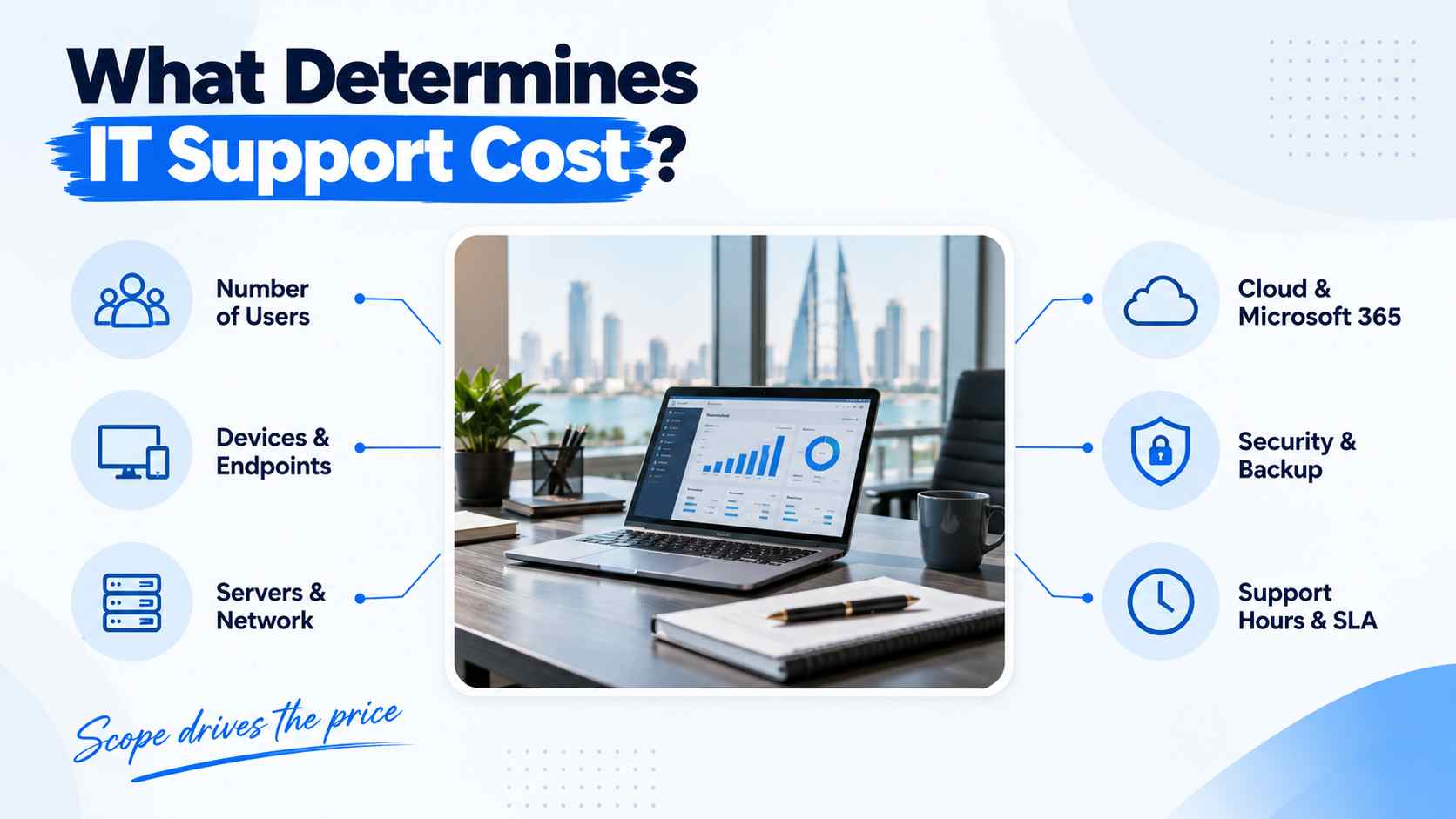
Every quote is built from the same set of inputs. Understanding them lets you predict roughly where your business will land before you speak to anyone.
People, endpoints and infrastructure
- Number of users: The biggest driver in most contracts: more users means more tickets, accounts and onboarding.
- Number of devices: Laptops, desktops, printers, tablets and business mobiles all need patching and monitoring.
- Number of locations: A second branch adds travel, site visits and a separate network to maintain.
- The highest support weight per unit: Domain controllers, file servers and ERP hosts need monitoring, patching and capacity planning.
- Network infrastructure: Firewalls, switches, access points and site-to-site links each add configuration load.
- Cloud services and Microsoft 365: Licence management, tenant configuration, security policies and user provisioning.
Risk and service level
- Cybersecurity requirements: Endpoint protection is baseline. Email security, MFA enforcement, vulnerability management and SOC monitoring each add cost, and each reduces risk.
- Backup and disaster recovery: Capacity, retention, offsite copies and recovery testing.
- Support hours: Business hours coverage is materially cheaper than 24/7, which requires staffed shifts.
- Response time and SLA: A four-hour and a one-hour response commitment are different products with different staffing behind them.
- On-site versus remote: Guaranteed on-site attendance within a fixed window costs more than remote resolution.
- Compliance requirements: Businesses handling personal data in Bahrain fall under the Personal Data Protection Law. Documentation and audit support take time, and time is priced.
Common IT Support Pricing Models
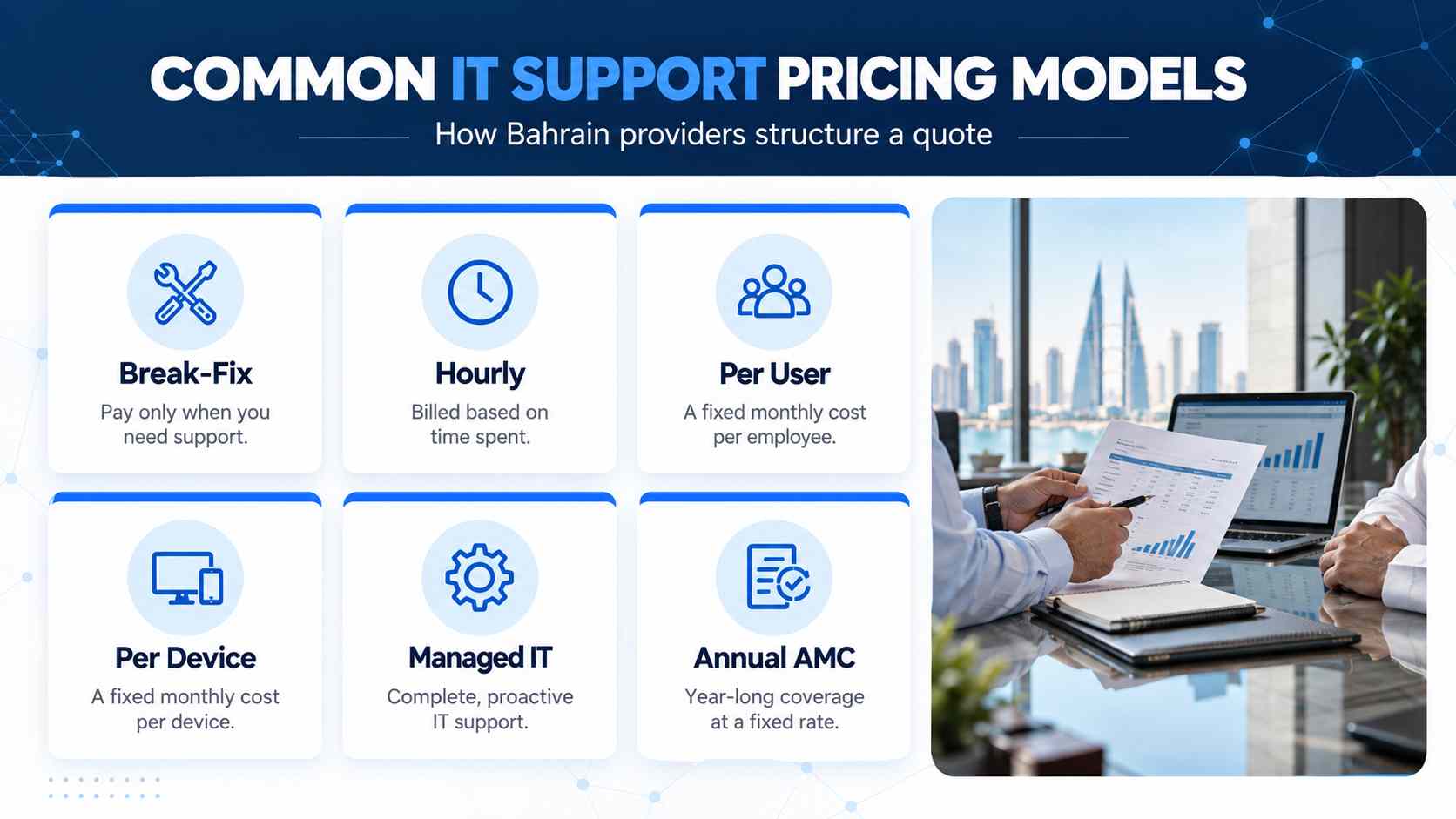
The model matters as much as the number, because it decides who absorbs the cost when something goes wrong.
Break-fix support
You call when something breaks and pay for the fix. No monthly commitment, no proactive work.
Hourly support
An agreed hourly rate, sometimes sold as a prepaid block. Common where some internal capability already exists.
Per-user pricing
A fixed monthly fee per supported employee, covering all the devices that person uses. Suits cloud-first offices.
Per-device pricing
A fixed monthly fee per managed endpoint or server. Suits shared-workstation environments such as retail counters, clinics and production floors, where device count does not track headcount.
Monthly managed IT services
A fixed monthly fee covering an agreed scope of proactive and reactive work: monitoring, patching, help desk, security management and regular reviews.
Annual IT AMC
An annual maintenance contract over a defined list of equipment and services, usually with scheduled preventive visits. Widely used across Bahrain and the GCC, and often the easiest model to get approved: one annual line item.
Hybrid pricing
A fixed monthly managed services fee for day-to-day support, with projects, hardware and out-of-scope work quoted separately.
| Pricing model | How it works | Best for | Advantages | Potential drawbacks |
| Break-fix | Pay per incident, no retainer | Very small offices with minimal IT | Lowest visible cost; no commitment | Unpredictable spend; no prevention; provider earns more when you have problems |
| Hourly | Agreed hourly rate or prepaid block | Businesses with partial in-house capability | Flexible; pay only for time used | Costs spike in a bad month; slower priority than contracted clients |
| Per-user | Fixed monthly fee per employee | Cloud-first offices, multi-device users | Simple to budget; scales with hiring | Can overcharge for light users; device-heavy sites pay more than they should |
| Per-device | Fixed monthly fee per endpoint or server | Shared workstations, retail, clinics, sites | Accurate for device-heavy environments | Headcount growth is not captured; needs an accurate asset list |
| Monthly managed IT | Fixed monthly fee for an agreed scope | SMEs wanting predictable, proactive support | Predictable spend; provider is paid to prevent problems | Requires a clear scope document; unused capacity in quiet months |
| Annual IT AMC | Annual contract over a defined equipment list | Businesses with fixed infrastructure and annual budgeting | One approved budget line; scheduled preventive maintenance | Scope is fixed for a year; additions may need a variation |
| Hybrid | Monthly retainer plus separately quoted projects | Growing SMEs with periodic change | Steady baseline cost, transparent project pricing | Requires clarity on what is in and out of scope |
What Is Included in IT Support?
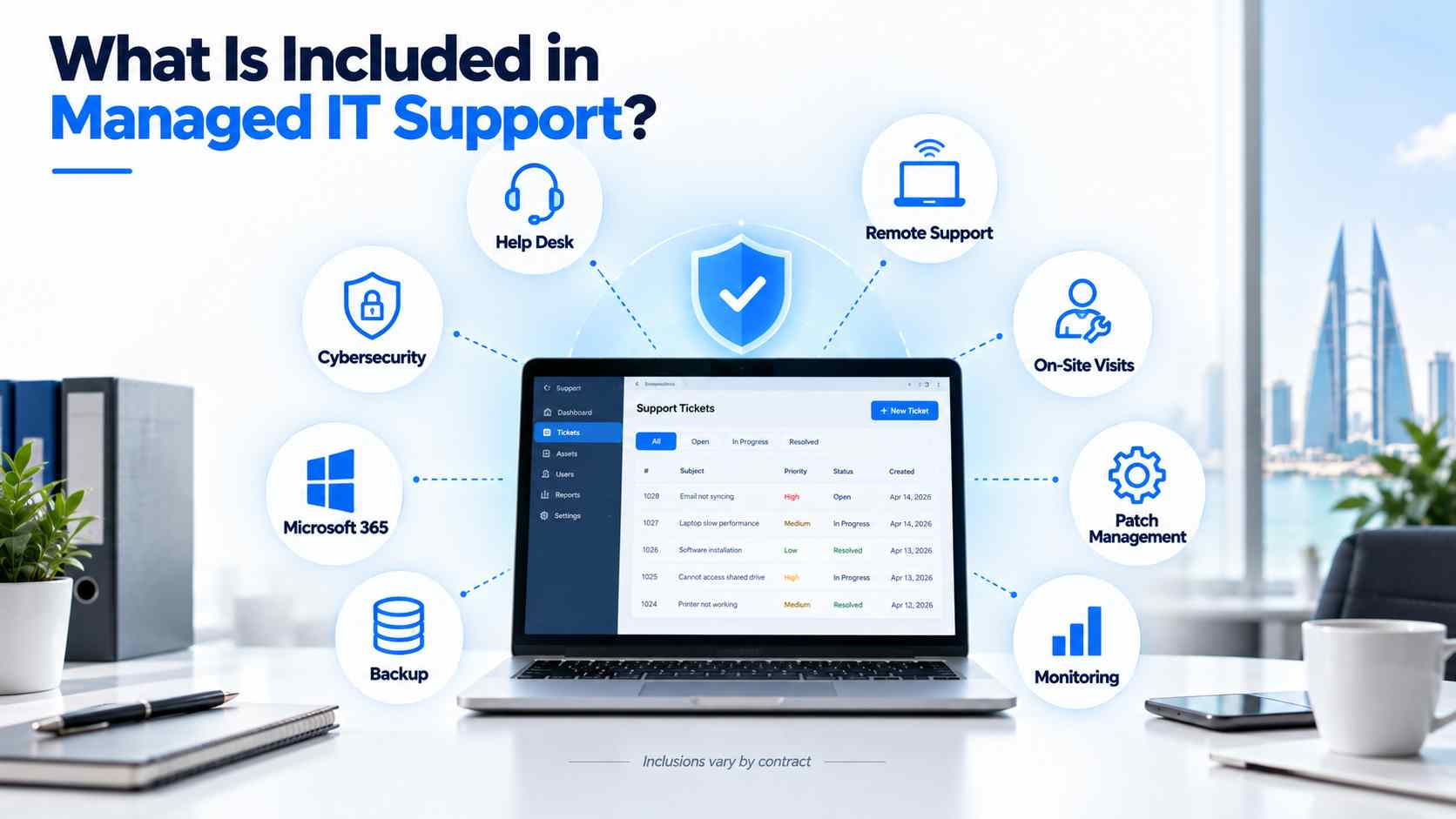
Inclusions vary significantly between contracts. Two providers can both call their offer “Managed IT Support” and deliver very different things, so this is what you may receive, not what every provider includes.
- Help desk and user support: by phone, email or ticket portal
- Remote and on-site support: the latter for hardware faults and anything that cannot be fixed remotely
- Network troubleshooting: across firewalls, switches, wireless and internet links
- Server support: monitoring, patching and capacity checks
- Microsoft 365 support: licences, mailboxes, security policies, SharePoint and Teams
- Device management: setup, joiners and leavers, asset records
- Patch management: for operating systems and common applications
- Monitoring and alerting: so problems are seen before users report them
- Backup management: and recovery testing
- Cybersecurity support: endpoint protection, email filtering, MFA, incident response
- Preventive maintenance and technical reviews
Ask for the inclusion list in writing, and ask what falls outside it. Exclusions are where budget surprises live.
Cheap IT Support vs Value-Driven IT Support
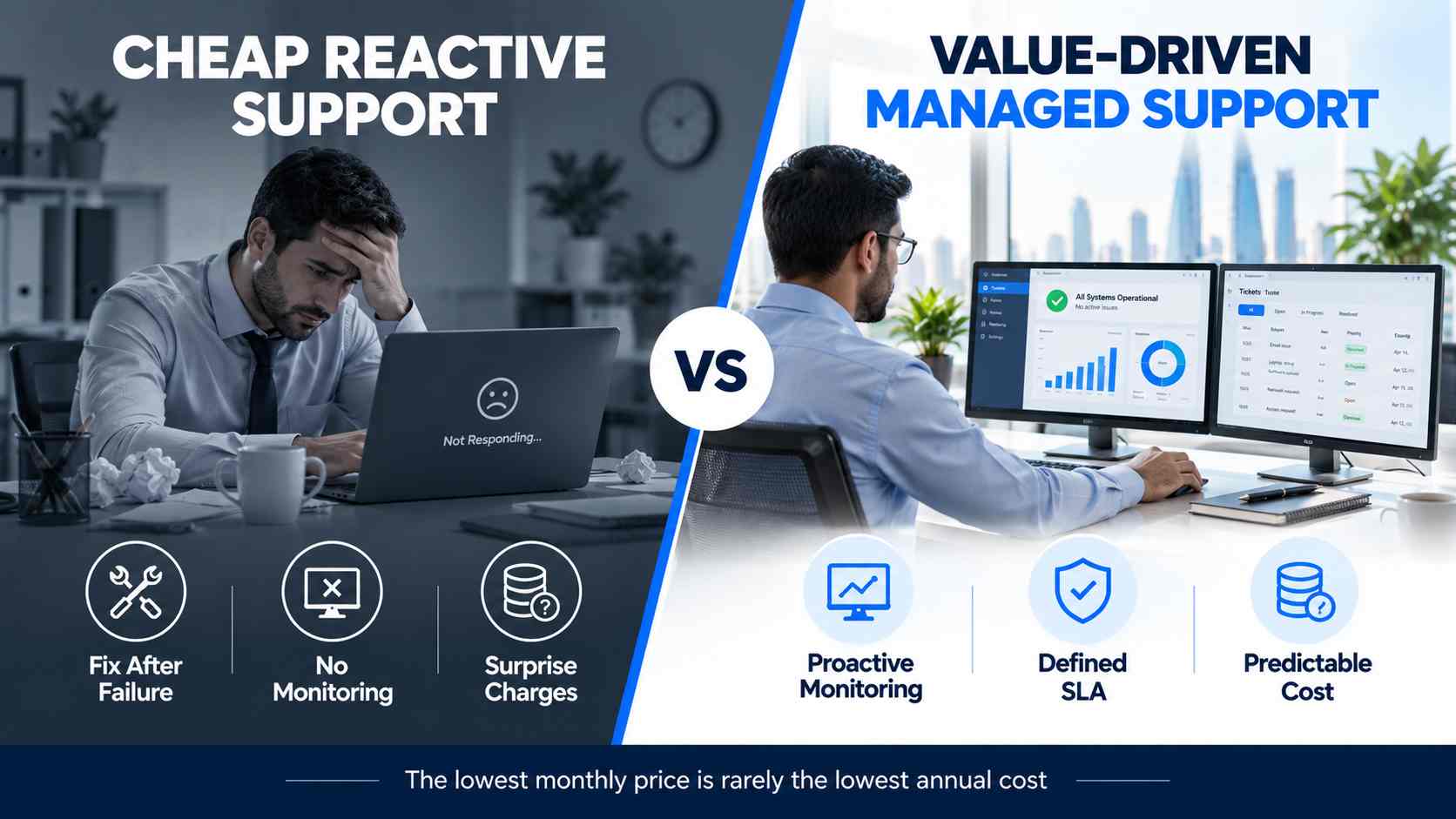
The lowest monthly price is rarely the lowest annual cost. A cheap contract saves money by removing the work you do not see: monitoring, patching, documentation, testing and review. Those are exactly the activities that stop incidents happening.
| Factor | Low-cost reactive support | Value-driven managed support |
| Approach | Responds after failure | Monitors and prevents |
| Downtime | Absorbed by your business | Actively minimised |
| Response | Best effort, no guarantee | Defined SLA and escalation path |
| Recurring issues | Symptoms fixed repeatedly | Root cause identified and closed |
| Security | Basic antivirus | Layered controls, patching, monitoring |
| Documentation | Little or none | Maintained asset and configuration records |
| Billing | Frequent additional charges | Predictable, with scope agreed upfront |
| Maintenance | None | Scheduled and reported |
| Real annual cost | Low fee, high incident spend | Higher fee, lower total disruption |
IT Support vs Hiring an In-House IT Team
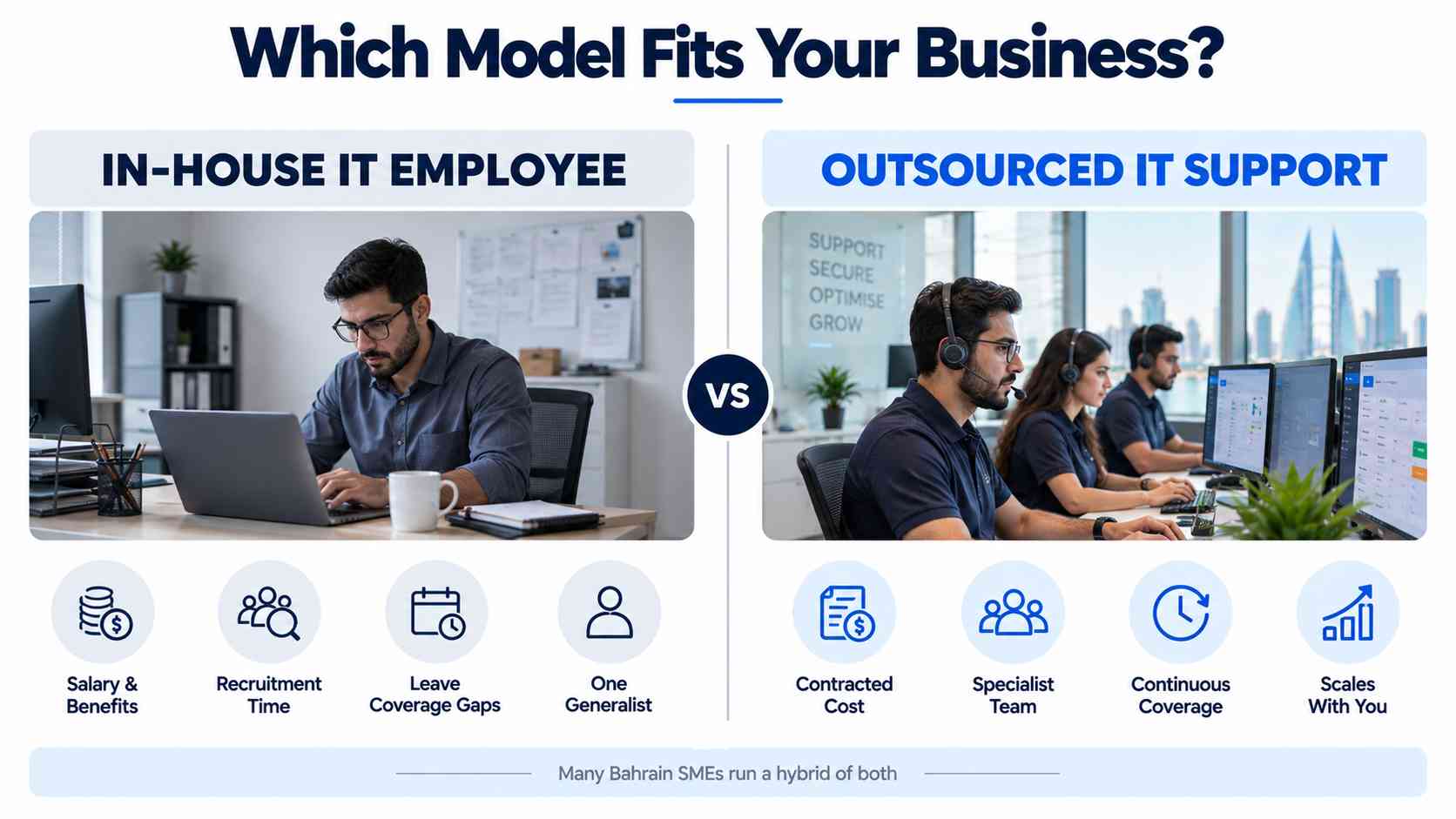
Outsourcing is not automatically cheaper, and anyone who says otherwise has not looked at your environment. The honest comparison is about coverage and capability, not just salary.
| Factor | In-house IT employee | Outsourced IT support |
| Cost structure | Salary, benefits, indemnity, visa and recruitment costs | Contracted fee, agreed in advance |
| Recruitment | Your responsibility, and slow to replace | Handled by the provider |
| Training | You fund certifications and upskilling | Included in the provider’s cost base |
| Leave coverage | Gaps during annual and sick leave | Continuous through a team |
| Expertise range | One generalist, strong in some areas | Network, server, cloud and security specialists |
| After-hours | Overtime or goodwill | Available where contracted |
| Scalability | New hire needed to grow | Adjust the contract |
| Business knowledge | Deep and immediate | Built over time, supported by documentation |
| Predictability | Fixed salary, variable tooling and project costs | Fixed contract cost, projects quoted separately |
An in-house hire often makes sense with complex bespoke systems, a large user base, constant internal project work, or requirements that demand someone on site daily.
Outsourced support often makes more sense when your team is under roughly forty users, you want specialist security and cloud skills without hiring three people, or you need coverage a single employee cannot provide.
Many Bahrain SMEs settle on a hybrid: one internal IT coordinator for day-to-day user needs, with an external partner covering infrastructure, security and escalation.
How SMEs Can Build an IT Support Budget
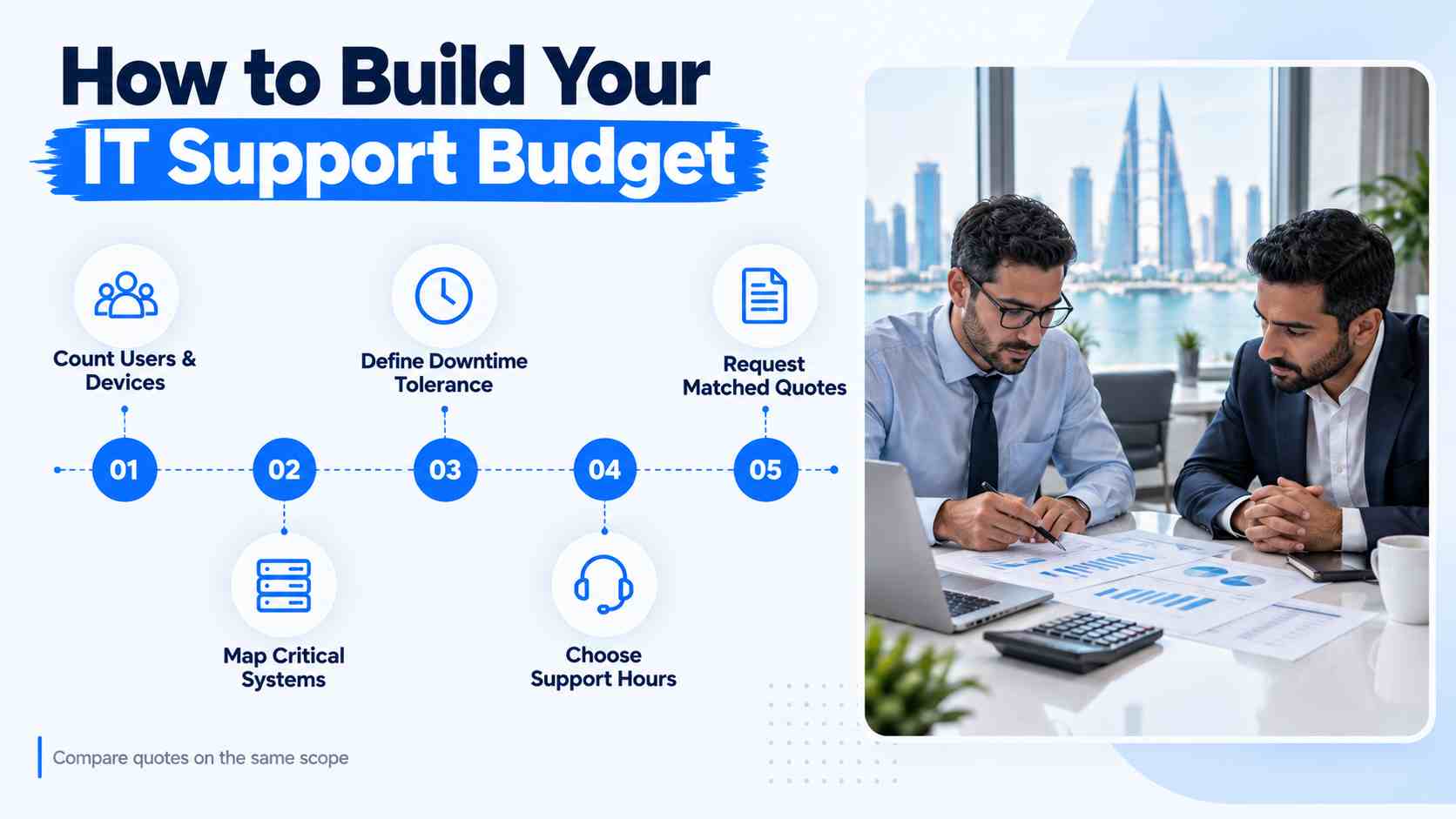
Do not start with a price. Start with an inventory, then ask providers to quote against it. That one change gives you comparable quotes instead of three documents that cannot be read side by side.
- Count your users and devices. Everyone using a computer or business application; every laptop, server, firewall, switch, access point and business mobile.
- List your locations. Head office, branches, warehouses, site offices.
- Map your business-critical systems. ERP, accounting, CRM, shared file storage: anything that stops revenue when it stops.
- Define your downtime tolerance. How long can you run without email? Without the server? That sets your SLA and backup requirement.
- Decide your support hours. Business hours, extended hours, or genuine 24/7.
- State your security and compliance position. Do you handle personal data or client records carrying contractual obligations?
- Add the change you expect this year. New hires, an office move, a cloud migration, a branch opening.
IT support budgeting worksheet
| Line item | What to record | Effect on cost |
| Supported users | Headcount using IT | Primary driver in per-user models |
| Managed endpoints | Laptops, desktops, shared PCs | Primary driver in per-device models |
| Servers | Physical and virtual | High weighting per unit |
| Network devices | Firewalls, switches, access points | Moderate weighting per unit |
| Locations | Sites needing on-site attendance | Adds travel and visit time |
| Microsoft 365 licences | Type and quantity | Licence cost plus administration |
| Backup volume and retention | GB or TB, and how far back | Storage and management cost |
| Security scope | Endpoint, email, MFA, monitoring | Scales with risk appetite |
| Support hours | Business, extended or 24/7 | Significant multiplier |
| Target response time | Per severity level | Significant multiplier |
| Annual project allowance | Migrations, refreshes, expansion | Keeps projects out of the monthly fee |
Illustrative example – actual pricing varies by provider and scope. A Manama professional services firm with 35 users, 48 endpoints, 2 servers, 1 firewall, 40 Microsoft 365 licences, one office and a four-hour response target takes that worksheet to three providers. Each quote is then normalised to cost per user per month, so three different commercial structures become directly comparable.
Hidden IT Costs SMEs Often Overlook
The IT budget line rarely captures the full cost of IT. These items surface in other departments’ numbers.
- Salaried staff unable to work, usually the largest hidden cost of all.
- Emergency repairs. Out-of-hours call-outs and urgent hardware purchases carry a premium.
- Data loss. Rebuilding records consumes weeks of staff time, assuming it can be rebuilt at all.
- Cybersecurity incidents. IBM’s 2026 Cost of a Data Breach Report put the average breach cost for Middle East organisations at USD 8 million, with lost business the largest component. That figure is weighted toward large enterprises, but the pattern holds down-market: recovery costs more than prevention.
- Hardware replacement. Machines kept years past their useful life generate tickets, not savings.
- Unplanned IT projects. A migration decided on Tuesday becomes an unbudgeted cost by Thursday.
- Productivity loss. Slow systems and poor network performance shave minutes off every task, every day, across every employee.
- Licensing gaps. Over-licensing wastes money; under-licensing creates compliance exposure.
Proactive support does not eliminate these costs, but monitoring, patching, tested backups and a documented environment reduce how often they appear.
When Should an SME Consider Managed IT Support?
If several of these describe your business, a managed arrangement is worth pricing.
- IT problems recur, and nobody is fixing the underlying cause.
- You have no dedicated IT employee, and the role has landed on whoever is most technical.
- Your team is growing, and onboarding is becoming disorganised.
- You have opened, or are opening, a second location.
- Phishing and fraud attempts are reaching your staff.
- You are planning a cloud migration or a Microsoft 365 rollout.
- Downtime is frequent enough that people plan around it.
- Backups exist, but nobody has tested a restore.
- Response is slow, with no escalation route.
- IT spend is unpredictable and hard to forecast.
How to Compare IT Support Providers in Bahrain
Price is one line in a comparison, not the comparison itself. Work through this checklist with each provider.
- Scope and exclusions: what is included in writing, and what is billed separately
- SLA: defined response times by severity, not vague assurances
- Support channels and hours: phone, email, portal, and after-hours arrangements
- On-site support: included visits, response window, travel charges
- Security capabilities: endpoint, email, patching, MFA, monitoring
- Backup and recovery: retention, offsite copies, restore testing frequency
- Monitoring: who watches the alerts, and what happens at 2am
- Local experience: Bahrain clients, comparable environments, references
- Documentation: asset registers, network diagrams, configuration records
- Escalation process: a named path when the first response does not resolve it
- Contract terms: duration, notice period, exit and handover
- Pricing transparency: how the number was built, and what changes it
IT Support Cost vs IT Business Value
Cost is what leaves the account. Value is what the spend protects.
Consider a thirty-person consultancy in Manama. Its file server fails on a Sunday morning with deliverables due Monday. Under a break-fix arrangement, someone notices at eight, calls at nine, waits for a technician, and two working days disappear before a replacement is sourced. Thirty people sit partially idle, a deadline slips, and a client relationship takes a hit that never appears on an invoice.
Under a managed arrangement with monitoring and tested backups, the alert fires before anyone arrives and recovery runs from a verified copy. The business loses hours instead of days.
The difference is not technical skill. It is whether someone was paid to watch, patch, test and document in advance. That is what a managed IT support fee buys: reduced risk, protected productivity, business continuity, and a security posture you can describe to a client or auditor without hesitation. Bahrain’s regulatory environment reinforces the point, since the Personal Data Protection Law places clear obligations on organisations handling personal data, with penalties for non-compliance.
Why Choose Nada Computers Bahrain
Nada Computers W.L.L. works with Bahrain businesses across business IT support, managed IT services and IT AMC arrangements, with plans built around what a business actually runs rather than a fixed tier list.
Capabilities include proactive maintenance, network infrastructure support, server and data centre solutions, cloud services and Microsoft 365, cybersecurity, backup and disaster recovery, and monitoring where the contract calls for it. Support is delivered locally, which matters when an issue needs someone on site rather than on a call from another time zone.
Pricing follows an assessment of users, devices, infrastructure, support hours and response times, so the proposal reflects your environment rather than an assumption about it.
Conclusion
So, how much does IT support cost in Bahrain? It costs what your environment requires. Users, devices, servers, cloud services, security scope, support hours and response times determine the figure, and any provider quoting before understanding those inputs is guessing.
Build your inventory first. Define the downtime you can tolerate. Then ask two or three providers to quote against the same scope, and compare inclusions, SLA, security coverage and escalation alongside the monthly number. The cheapest contract is rarely the cheapest year.
For a costing based on your actual environment rather than a generic range, Nada Computers can assess your users, devices and infrastructure and prepare a customised IT support proposal for your business in Bahrain.
8. Comparison Tables
The article contains four comparison tables, positioned as follows:
- IT Support Pricing Models Comparison: in Common IT Support Pricing Models
- Cheap vs Value-Driven IT Support: in Cheap IT Support vs Value-Driven IT Support
- In-House IT vs Outsourced IT Support: in IT Support vs Hiring an In-House IT Team
- IT Support Budgeting Worksheet: in How SMEs Can Build an IT Support Budget
9. IT Support Budgeting Framework
Step 1: Inventory. Record users, endpoints, servers, network devices, locations and Microsoft 365 licences.
Step 2: Criticality. List the systems that stop revenue when they stop, and rank them.
Step 3: Downtime tolerance. Define, per system, how long the business can operate without it. This sets both SLA and backup requirements.
Step 4: Coverage. Choose business hours, extended hours or 24/7, and define response targets by severity.
Step 5: Security and compliance. Document the data you hold, the obligations attached to it, and the controls you already have.
Step 6: Change forecast. Add expected headcount growth, office moves, migrations and hardware refresh due within twelve months.
Step 7: Request comparable quotes. Issue the same worksheet to every provider and require quotes against it.
Step 8: Normalise and compare. Convert every quote to cost per user per month, then compare inclusions, exclusions, SLA and escalation.
Step 9: Separate the project allowance. Hold a distinct annual budget for migrations, hardware replacement and expansion so the monthly support fee stays predictable.
Step 10: Review quarterly. Reconcile actual ticket volumes, incidents and out-of-scope charges against the contract, and adjust at renewal.
10. FAQs
How much does IT support cost in Bahrain?
There is no single published rate. Bahrain providers quote against scope, and the final figure depends on how many users and devices you have, whether you run servers, what cloud services you use, your security requirements, your support hours and your agreed response times. Providers price hourly, per user, per device, as a monthly managed service or as an annual AMC. The reliable approach is to document your environment, request quotes from two or three providers against that same scope, and compare inclusions rather than headline figures.
How much should a small business spend on IT support?
Enough to cover the systems your revenue depends on, with the response speed your operations require. Rather than working from a percentage, build the number from the bottom up: count users and devices, identify business-critical systems, define how long you can operate without each one, and decide your support hours. That inventory turns into a realistic budget once providers quote against it. Remember to hold a separate annual allowance for projects and hardware replacement so monthly costs stay stable.
Is outsourced IT support cheaper than hiring an IT employee?
Sometimes, but not always. An in-house hire carries salary, benefits, recruitment, training and leave-coverage costs, and gives you one generalist. An outsourced contract gives you a team with network, server, cloud and security specialists at a contracted cost. For smaller teams, outsourcing usually provides broader capability for a more predictable spend. For larger organisations with complex bespoke systems or daily on-site needs, an internal hire or a hybrid arrangement often works better.
What is included in managed IT support?
Inclusions vary by contract, so always ask for the list in writing. Typical coverage includes help desk and user support, remote support, monitoring and alerting, patch management, device management, server and network support, Microsoft 365 administration, backup management and endpoint security. On-site visits, after-hours coverage, project work and hardware are handled differently by different providers. The exclusions list matters as much as the inclusions list, because that is where unbudgeted charges originate.
What is an IT AMC?
An IT Annual Maintenance Contract covers an agreed list of equipment and services for a twelve-month period, usually including scheduled preventive maintenance alongside reactive support. It is widely used in Bahrain and across the GCC because it converts IT support into a single annual budget line that finance teams can approve. The important details are which assets are covered, how many preventive visits are included, what response times apply, and how additions during the year are handled.
How do I choose an IT support company in Bahrain?
Compare scope before price. Ask each provider for written inclusions and exclusions, defined SLA response times by severity, support channels and hours, on-site arrangements, security and backup coverage, monitoring arrangements, escalation path and contract exit terms. Ask about local Bahrain experience with comparable environments, and request references. Then normalise every quote to the same basis. A provider that explains how the number was built is usually easier to work with than one quoting the lowest figure.