AMC vs Managed Services vs Break-Fix: IT Support Guide
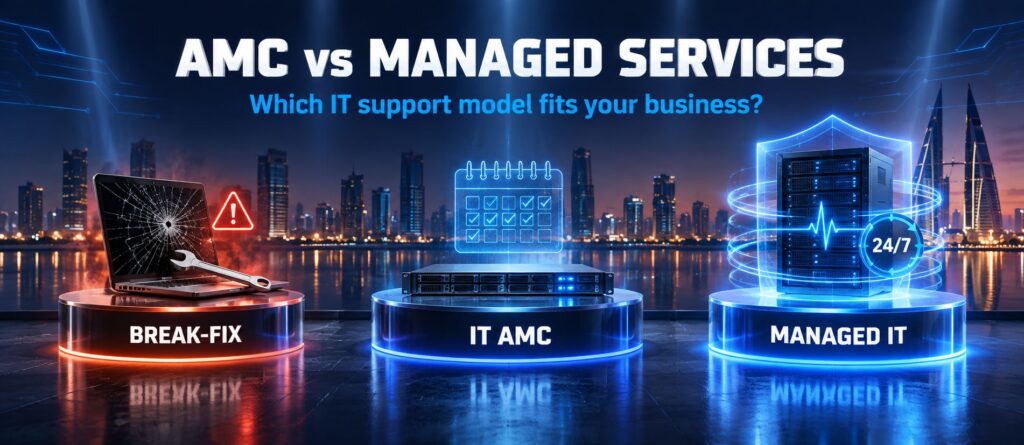
AMC vs Managed Services vs Break-Fix: Which IT Support Model Fits Your Business? Most companies don’t choose an IT support model on purpose. Someone calls a technician when the file server stops responding, calls again when Outlook won’t sync, and one day the finance manager adds up a year of invoices. That is usually when the AMC vs managed services question reaches the management table. In Bahrain, businesses typically choose between three arrangements: break-fix support, an IT Annual Maintenance Contract (AMC), and managed IT services. Each solves a different problem. None of them is right for every company, and a provider who says otherwise is usually describing the model they prefer to sell. This guide puts the three IT support models side by side. It covers what an AMC realistically includes, where managed IT services go further, how pricing is structured, and the signs that a business has outgrown break-fix. The goal is to help you judge which IT support model fits your operation, risk and budget. What Are the Three Main IT Support Models? The three models differ on two points: when the provider gets involved, and how much of your environment they are responsible for. Break-Fix IT Support Break-fix is reactive IT support. Nothing happens until something fails. You call a provider, they diagnose and repair the issue, and you pay for the time, parts and sometimes a call-out fee. There is no ongoing commitment on either side. IT AMC An IT AMC, or Annual Maintenance Contract, is a yearly IT maintenance contract in which a provider looks after a defined list of IT assets. It usually combines scheduled preventive maintenance with troubleshooting when problems occur. The fee is fixed for the contract term, and what is covered depends entirely on the contract wording. Managed IT Services With managed IT services, the provider takes ongoing responsibility for operating, monitoring and maintaining agreed parts of your IT environment, usually for a recurring monthly fee and against an IT support SLA. The emphasis shifts from repairing faults to preventing them. AMC vs Managed Services: What’s the Difference? An IT AMC covers scheduled maintenance and troubleshooting for a defined list of IT assets for a fixed annual fee. Managed IT services go further: the provider continuously monitors and manages your network, servers, endpoints, security and cloud systems under an SLA, aiming to prevent problems rather than repair them after they occur. In practice, the line is not always clean. Some Bahrain providers bundle remote monitoring into their AMC packages, and some offerings sold as “managed services” are little more than a help desk with a monthly invoice. The table below shows how the two models typically compare, but the contract you sign is what actually defines your coverage. Comparison Table: IT AMC vs Managed IT Services Factor IT AMC Managed IT Services Support approach Scheduled maintenance plus troubleshooting for listed assets Ongoing responsibility for operating and managing defined IT services Proactive maintenance Preventive visits at agreed intervals (for example, monthly or quarterly) Continuous, often automated patching, updates and health checks Monitoring Usually limited or not included unless specified in the contract Typically included for servers, network devices and endpoints, as scoped Response Defined in the contract, often business hours only SLA-based response and resolution targets, with priority levels Scope Named hardware and devices; network and servers where listed Wider environment: users, devices, network, servers, cloud and security, as scoped Pricing structure Fixed annual fee, often based on asset count and type Recurring monthly fee, often per user, per device or by tier Predictability High for covered items; exclusions billed separately High, with fewer out-of-scope charges when scope is broad Cybersecurity Basic checks and updates, if included Endpoint protection, patching and security monitoring; depth varies by provider Cloud support Often limited or excluded Commonly includes Microsoft 365 and cloud administration Network management Maintenance and troubleshooting during visits or on request Ongoing monitoring, configuration and firewall management Reporting Service visit and maintenance reports Regular reports on performance, tickets, security and recommendations Scalability Usually amended at renewal when assets change Adjusts as users and devices change, per contract terms Best suited for Stable, smaller environments that need reliable upkeep Growing or IT-dependent businesses that need continuous oversight Typical characteristics only. Actual coverage depends on each provider’s contract and service schedule. Break-Fix vs AMC vs Managed IT Services Adding break-fix to the picture makes the trade-offs easier to see. This IT support model comparison summarises how each option works in day-to-day operation, with all three IT support models compared on the points that matter most to SMEs. Comparison Table: Break-Fix vs IT AMC vs Managed IT Services Aspect Break-Fix IT AMC Managed IT Services How the model works Pay per incident when something breaks Annual contract for maintenance and support of listed assets Ongoing monitoring and management under a recurring agreement Typical business use case Micro-office, or company with in-house IT Small to mid-sized business with stable IT Growing, multi-site or IT-dependent business Main advantage No fixed commitment Scheduled upkeep at a fixed annual cost Issues detected and handled early Main limitation Unpredictable costs and longer downtime Gaps between visits; scope limited by contract Higher recurring fee; value depends on scope Support style Reactive Preventive and reactive Proactive and continuous Cost predictability Low High for covered items High across a broader scope Preventive maintenance None unless requested Scheduled, as per contract Ongoing, often automated Monitoring None Limited or optional Typically included Best suited business type Very small, low-risk setups Stable SMEs needing maintenance SMEs and corporates where IT is business-critical What Is Break-Fix IT Support? Break-fix is the simplest arrangement, and many small businesses start here without deciding to. A laptop won’t boot, you call a technician, and you pay for the visit, labour and parts. There is no contract and no recurring fee. Advantages of Break-Fix Support No fixed monthly or annual commitment. You pay only when support is actually needed. Simple to arrange for one-off problems or small projects. Can
IT Support Cost in Bahrain: 2026 Pricing Guide for SMEs

How Much Does IT Support Cost in Bahrain? A 2026 Pricing Guide for SMEs Most IT conversations in Bahrain reach the same question within the first few minutes of a meeting: what is this actually going to cost us? It is a fair question, and one that no honest provider can answer on the spot. A twelve-person trading office in Manama and a sixty-person contractor with a site office in Sitra and a branch in Riffa are both SMEs, but they will not pay anything close to the same amount. One needs email, laptops and someone to call when the internet drops. The other needs server uptime, multi-site connectivity, tested backups, and someone accountable at eleven at night. That is why IT support cost in Bahrain is quoted as a range rather than a rate card. The price reflects scope: how many people you support, how much infrastructure sits behind them, how fast you need a response, and how much risk you are asking the provider to carry. This guide breaks down what drives the number, the pricing models you will encounter, and how to build an IT support budget you can defend in a management meeting. How Much Does IT Support Cost in Bahrain? There is no published market rate for IT support in Bahrain. Providers here quote against scope and price privately, so any figure advertised as “the Bahrain rate” should be treated with caution. What can be said clearly is how pricing is structured. Bahrain providers typically quote in one of four ways: an hourly or call-out rate, a monthly fee per user, a monthly fee per device, or an annual IT AMC covering an agreed list of equipment and services. Larger contracts often blend these, with a fixed retainer plus project work billed separately. International benchmarks exist, but read them carefully. Published guides from North American providers commonly place fully managed IT support between USD 100 and USD 400 per user per month. That is United States and Canada data, shaped by local salary structures and compliance regimes, and it shows how wide the range runs even inside one market. It is not a Bahrain price, and converting it into dinars will not give you a realistic local budget. The practical takeaway: collect two or three quotes built on the same scope, then compare what each includes. A monthly figure means nothing until you know how many hours, how many devices, what response time and what security coverage sit underneath it. What Determines IT Support Cost? Every quote is built from the same set of inputs. Understanding them lets you predict roughly where your business will land before you speak to anyone. People, endpoints and infrastructure Number of users: The biggest driver in most contracts: more users means more tickets, accounts and onboarding. Number of devices: Laptops, desktops, printers, tablets and business mobiles all need patching and monitoring. Number of locations: A second branch adds travel, site visits and a separate network to maintain. The highest support weight per unit: Domain controllers, file servers and ERP hosts need monitoring, patching and capacity planning. Network infrastructure: Firewalls, switches, access points and site-to-site links each add configuration load. Cloud services and Microsoft 365: Licence management, tenant configuration, security policies and user provisioning. Risk and service level Cybersecurity requirements: Endpoint protection is baseline. Email security, MFA enforcement, vulnerability management and SOC monitoring each add cost, and each reduces risk. Backup and disaster recovery: Capacity, retention, offsite copies and recovery testing. Support hours: Business hours coverage is materially cheaper than 24/7, which requires staffed shifts. Response time and SLA: A four-hour and a one-hour response commitment are different products with different staffing behind them. On-site versus remote: Guaranteed on-site attendance within a fixed window costs more than remote resolution. Compliance requirements: Businesses handling personal data in Bahrain fall under the Personal Data Protection Law. Documentation and audit support take time, and time is priced. Common IT Support Pricing Models The model matters as much as the number, because it decides who absorbs the cost when something goes wrong. Break-fix support You call when something breaks and pay for the fix. No monthly commitment, no proactive work. Hourly support An agreed hourly rate, sometimes sold as a prepaid block. Common where some internal capability already exists. Per-user pricing A fixed monthly fee per supported employee, covering all the devices that person uses. Suits cloud-first offices. Per-device pricing A fixed monthly fee per managed endpoint or server. Suits shared-workstation environments such as retail counters, clinics and production floors, where device count does not track headcount. Monthly managed IT services A fixed monthly fee covering an agreed scope of proactive and reactive work: monitoring, patching, help desk, security management and regular reviews. Annual IT AMC An annual maintenance contract over a defined list of equipment and services, usually with scheduled preventive visits. Widely used across Bahrain and the GCC, and often the easiest model to get approved: one annual line item. Hybrid pricing A fixed monthly managed services fee for day-to-day support, with projects, hardware and out-of-scope work quoted separately. Pricing model How it works Best for Advantages Potential drawbacks Break-fix Pay per incident, no retainer Very small offices with minimal IT Lowest visible cost; no commitment Unpredictable spend; no prevention; provider earns more when you have problems Hourly Agreed hourly rate or prepaid block Businesses with partial in-house capability Flexible; pay only for time used Costs spike in a bad month; slower priority than contracted clients Per-user Fixed monthly fee per employee Cloud-first offices, multi-device users Simple to budget; scales with hiring Can overcharge for light users; device-heavy sites pay more than they should Per-device Fixed monthly fee per endpoint or server Shared workstations, retail, clinics, sites Accurate for device-heavy environments Headcount growth is not captured; needs an accurate asset list Monthly managed IT Fixed monthly fee for an agreed scope SMEs wanting predictable, proactive support Predictable spend; provider is paid to prevent problems Requires a clear scope document; unused capacity
Best Outdoor Security & Surveillance Systems
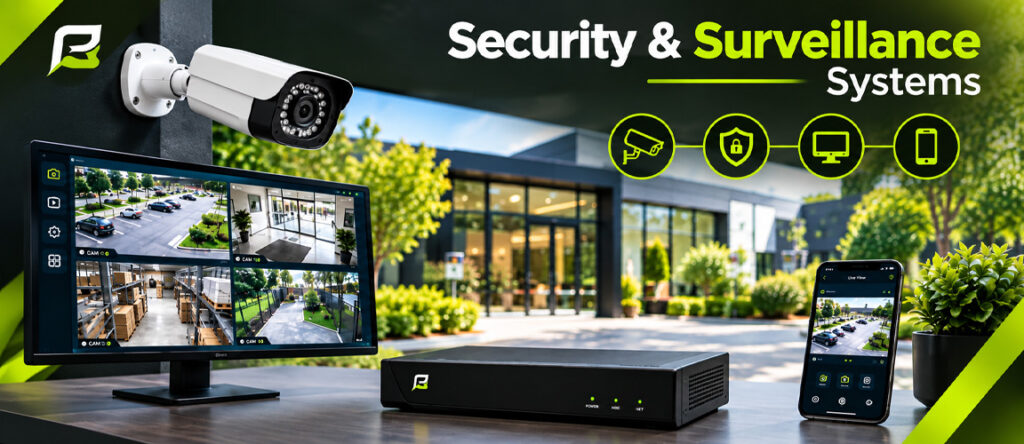
What is security & surveillance systems? Picking the best outdoor security camera surveillance system isn’t as simple as grabbing whatever’s top of the search results. Walk into any electronics shop or browse online, and you’ll find dozens of brands claiming to be “the best.” Some actually are. Most aren’t. So how do you tell the difference before you spend your money? That’s what this guide is for. No fluff, no sales pitch, just what actually matters when you’re setting up Security & Surveillance Systems for your home or business here in Bahrain. Whether you’re planning a fresh install or replacing an outdated setup, understanding what makes reliable Security & Surveillance Systems worth the investment will save you both time and money down the line. Why bother with a proper camera system in the first place? Let’s be honest, a lot of people put off installing cameras until something happens. A break-in, a package stolen off the porch, a dispute with a neighbor over “who parked where.” By then it’s too late to go back and record what happened. Good Security & Surveillance Systems flip that around. Instead of reacting after the fact, you’re watching things unfold in real time, or at least have solid footage to fall back on. And honestly, just having visible cameras up tends to make would-be troublemakers think twice before they even try anything. Today’s security surveillance camera systems don’t just sit there recording either. They’re smarter than that now, more on this shortly. What actually separates a good camera system from a mediocre one Not every camera on the market deserves the label “premium,” even if the price tag says otherwise. If you’re comparing options and trying to land on the best security surveillance camera system for your situation, keep an eye out for these: Housing that can actually handle Bahrain’s heat and dust,cheap plastic casings crack faster than you’d think Real night vision, not the washed-out kind that turns everything into a grey blur Sharp enough resolution to make out a face or a number plate, not just a blob moving across the screen Wide-angle coverage so you’re not left with awkward gaps between cameras Storage that won’t quietly fail on you right when you need the footage most Cameras that tick these boxes tend to earn their price. The ones that don’t usually end up disappointing someone within the first year. Outdoor cameras: what to look for before you buy Outdoor placement is a different game altogether. Sun exposure, sandstorms, the occasional heavy rain — all of it wears equipment down faster than people expect. That’s exactly why the best outdoor security camera systems for home surveillance are built differently from the ones meant for indoor hallways. A few things worth prioritizing Weatherproofing rated at IP66 or better — dust and moisture resistance, basically Infrared night vision that reaches at least 20-30 meters Motion-triggered recording, so your storage isn’t clogged with hours of an empty driveway Two-way audio, useful for talking to whoever’s at your gate without opening the door A mobile app that actually sends alerts you’ll notice Placement matters more than people give it credit for, too. Front doors, back gates, driveways, side windows — these are the spots that matter. A camera pointed at your garden wall isn’t doing much for you. Get the coverage right, and your home security cameras will actually catch what you need them to. Home security cameras have come a long way It used to be that a camera just… recorded. That was the whole job. Now, home security cameras do a lot more — live streaming to your phone, instant push alerts, two-way talk, even integration with your doorbell and smart lighting. The stuff worth paying attention to: Notifications the moment motion is picked up Live footage you can pull up from anywhere Cloud backup, so even if someone messes with the camera itself, the footage isn’t gone Smart home integration, tying cameras into alarms and lights Once your property is properly monitored by camera, there’s a shift in how you think about security. You’re not guessing anymore. You know. CCTV & video surveillance in Bahrain Bahrain’s grown fast over the last decade. New neighborhoods, more commercial buildings, higher property values, and with that comes more demand for CCTV & video surveillance Bahrain solutions. Whether it’s a villa in Riffa or a warehouse tucked away in Sitra, cameras have quietly become part of the standard setup rather than an afterthought. Local providers have caught up too. Instead of generic, one-size-fits-all packages, there’s now a real push toward systems built around Bahrain’s climate and the specific layout of local properties. What actually happens during CCTV installation CCTV installation Bahrain services involve a lot more than screwing a camera to a wall and calling it done. A proper job typically looks like this Walking the property to spot weak points and blind spots Mapping out where each camera should go for the widest coverage without wasteful overlap Sorting out cabling — or going wireless, or PoE, depending on the setup Getting the NVR or DVR configured properly Setting up remote access so you can actually check footage from your phone Testing everything — night vision, motion triggers, alerts — before calling it finished. DIY installs seem tempting on paper. Cheaper upfront, sure. But wrong angles, weak signal, sloppy wiring — these mistakes show up later, usually right when you actually need the footage. Get it installed properly the first time and you won’t be troubleshooting it six months down the line. AI is changing what surveillance even means The biggest leap in recent years has been AI-powered surveillance. Cameras used to just record — now they can actually make sense of what they’re seeing. Some of the more useful capabilities: Filtering out irrelevant motion, like tree branches swaying or a stray cat wandering through Perimeter alerts that fire the moment someone crosses a line you’ve set Spotting unattended bags or vehicles that don’t belong Flagging
Best Network Infrastructure Solutions in Bahrain

What’s actually included in a proper network infrastructure setup for a growing business? Network Infrastructure Solutions bring together structured cabling, routers and switches, wireless coverage, and network security into one connected system, so your business stays online, secure, and ready to scale without a full rebuild every few years. I’ve lost count of how many offices I’ve walked into where the network was basically an afterthought. Someone bought a decent router years back, ran a few cables along the skirting board, called it a day. And honestly, it worked. For a while. Then the company hired ten more people. Added a CCTV system. Moved half the accounting software to the cloud without really thinking about what that meant for the actual wiring underneath it all. Suddenly the whole thing started falling apart, usually during the busiest hour of the day, because that’s just how these things go. That’s about the point someone calls asking for network infrastructure solutions. By then it’s rarely a small fix. What is Network Infrastructure Solutions? Network infrastructure solutions are the combined cabling, routers, switches, wireless access points, and security setup that let every device in a business connect, communicate, and stay protected. They’re what keep an office running without downtime as the business grows or shifts more work to the cloud. What People Actually Mean When They Say “Network Infrastructure? Strip away the jargon and network infrastructure solutions really just mean the wiring, the equipment, and the setup that let every device in a business talk to each other and to the internet without breaking a sweat. That’s genuinely it. Physical cabling running through your walls. Equipment moving traffic around. Wireless coverage across the floor. Security sitting in front of all of it, hopefully. A good setup is one you never think about, ever. A bad one is why your team’s WhatsApp group has more work traffic than your actual shared drive, because the shared drive keeps timing out at 2pm every single day like clockwork. Why This Keeps Coming Up in Bahrain Right Now Something’s shifted here over the last couple of years. Not subtly either. Businesses that used to run everything off a local server tucked in a corner are now splitting operations between the office and the cloud, sometimes without even fully deciding to. Banks and regulated firms are under closer scrutiny from the CBB these days, which means network security stopped being a checkbox a while ago. Now it’s something an auditor actually asks about, in detail, and you’d better have an answer. Even smaller retail and hospitality places are running point-of-sale systems, guest Wi-Fi, and back-office tools all on the same connection. A lot of the time nobody’s thought about how much strain that puts on equipment that was bought three or four years ago and hasn’t been touched since. None of this is dramatic on its own, to be fair. It just piles up quietly until the network genuinely can’t keep pace with the business running on top of it. That’s usually the exact moment somebody starts googling network infrastructure solutions in Bahrain instead of duct-taping the old setup together for one more quarter. Structured Cabling Is Where Most Problems Actually Start For the wired side, structured cabling is the part people underestimate the most, and I get why, it’s not exactly exciting to talk about. I’ve walked into buildings where the original cabling was done cheaply a decade ago. Every “network problem” since has actually just been that same cabling problem wearing a different costume. A properly built LAN inside the office is what everything else sits on top of, whether people realize it or not. If you’re linking more than one branch, a well-planned WAN connection is what stops each site from feeling like its own little island cut off from the others. Routing And Switching Keep Everything Moving Cabling gets the signal into the room, sure. But routers and switches are what actually decide where that traffic goes, and how fast it gets there. Larger setups spanning multiple offices often lean on edge platforms to connect branch locations back to a central network. Sometimes that’s over dedicated MPLS lines, when speed and consistency matter more than shaving a bit off the monthly bill. Get this layer wrong and the symptoms show up everywhere else first, honestly. Slow file transfers. Laggy video calls. Apps that time out for reasons nobody in the office can explain, and they’ll blame the internet provider every time, even when it’s not that at all. Wireless Coverage Isn’t Optional Anymore Nobody wants to be tethered to a desk anymore, and fair enough, why would they be. Proper WLAN access points, placed with some actual thought behind them, fix that classic complaint everyone knows: strong signal at the front desk, basically nothing the moment you walk past the second door. Bigger deployments increasingly lean on wireless network infrastructure built around Wi-Fi 6, which handles a lot more connected devices without the whole thing choking under load. A single set of access points managed through one central WLAN controller is a lot easier to maintain than a dozen routers nobody remembers configuring, tucked away in random cabinets across the building. How the wireless side breaks down on a real project Wireless Element What It Solves Common Mistake Access point placement Removes dead zones across the office Installed based on convenience, not actual coverage Wi-Fi 6 standard Supports far more connected devices at once Left running on hardware years past its prime Centralized controller Manages every access point from one place Each device configured separately, nobody tracking it Guest network separation Keeps visitor traffic off the internal network Guests and staff sharing the exact same access point Security Has To Be Built In, Not Bolted On Firewalls are the obvious starting point. Most businesses at least have one of those. What they often miss is everything sitting behind it. Intrusion detection catches traffic that looks off but hasn’t quite triggered an outright block yet,
Top ELV Solutions in Bahrain

ELV solutions in bahrain into Google and you’ll get a dozen results, all claiming to be the market leader. None of them tell you what actually separates a good ELV installer from one that will leave you troubleshooting a dead camera feed six months from now. That’s the gap this article fills. If you’re trying to find the best ELV company in Bahrain, the honest answer is: it depends on what you’re building, who’s regulating you, and how much support you’ll need once the installation crew packs up. Every provider on the market wants to be seen as the best ELV company in Bahrain, but few actually back that claim with real client history. A villa owner installing smart lighting has different priorities than a bank installing biometric access control. This guide walks through both, what ELV actually covers, how the Bahraini market is structured, and why Nada Computer has quietly become one of the names enterprise and government clients keep coming back to. ELV Solutions in Bahrain ELV (Extra-Low Voltage) refers to any electrical system running below roughly 50 volts, low enough to be safe to touch, but powerful enough to run some of the most important infrastructure in a building. It’s a strange category, because on paper it sounds minor, yet it includes CCTV systems Bahrain businesses rely on for security and liability protection Access control systems Bahrain organizations use to manage who enters restricted areas Structured cabling Bahrain networks that carry every byte of data your business generates Fire alarm and public address systems Intercoms and video door entry Building automation, lighting control, and guest room management Data center and UPS backup infrastructure Elv Solutions Meaning refer to the group of electronic systems built around signals and control rather than raw electrical power,operating at voltages low enough (typically under 50V) to be safe on continuous human contact, unlike standard mains wiring used for lighting or heavy equipment. Think of it as the difference between a building’s power supply and its nervous system. While regular electrical work keeps the lights on, ELV handles everything that makes a building aware and responsive, CCTV cameras watching entry points, access control systems deciding who gets through a door, structured cabling moving data between floors, fire alarms sensing danger before it spreads, and automation systems adjusting lighting or climate on their own. Put simply, ELV Solutions is the umbrella term for designing, installing, and maintaining this entire low-voltage layer that keeps a modern building secure, connected, and self-managing. Why the Provider You Pick Actually Matters A badly wired access control panel doesn’t announce itself as a problem — until the day someone walks through a door they shouldn’t have access to, and there’s no log to explain how. This is the uncomfortable reality of ELV work: failures are silent until they’re expensive. A few things are genuinely at stake Regulatory compliance. Banks, ministries, and healthcare providers in Bahrain operate under strict local rules about data handling and security infrastructure. Your installer needs to understand those rules, not just meet the minimum wiring code. What happens after installation day. Firmware ages. Cameras drop offline. Someone needs to be watching. How well systems talk to each other. CCTV, door access, and your network shouldn’t be three separate headaches managed by three separate vendors. Whether the setup can grow with you, instead of needing to be ripped out in three years. Comparing ELV Provider Types in Bahrain Not every company selling ELV services in the Kingdom is built the same way. Here’s a practical breakdown of what you’ll typically run into when searching for the best ELV company in Bahrain, and why the label gets thrown around so loosely Provider Type Typical Strength Typical Weakness Large diversified conglomerates Brand recognition, financial stability ELV is one of many divisions — rarely the priority Legacy ICT/cabling integrators Strong vendor relationships, hardware sourcing Older infrastructure, limited cybersecurity depth Retail companies with an ELV add-on Convenient if already a customer ELV isn’t core business, thin technical bench Telecom-backed enterprise providers Strong connectivity backbone ELV often bundled, less specialized attention Focused IT + ELV specialists Integrated systems, in-house engineers, ongoing support Smaller brand footprint than conglomerates If your building needs ELV solutions Bahrain clients can actually rely on for years — not just a one-time install, the last category on that table is usually where the real value sits. This is the space that companies competing for the best ELV company in Bahrain title are supposed to occupy, and it’s where Nada Computer operates. Why Nada Computer Earns the Best ELV Company in Bahrain? Nada Computer has been operating out of Al Qudaybiyah, Manama since 2008, and in that time has built infrastructure for banks, ministries, hospitals, and enterprise clients across Bahrain and the wider GCC. A few specifics worth knowing: Everything under one roof. Instead of coordinating five vendors for cabling, cameras, access control, and network security, Nada handles ELV, network infrastructure, cybersecurity, and digital services as one accountable team. Fewer handoffs, fewer excuses when something goes wrong. A process, not a guess. Projects move through a defined Consultation → Architecture → Deployment → Management cycle, so clients aren’t left wondering what stage their project is at. 24/7 monitoring. Given how silently ELV systems fail, round-the-clock monitoring catches an offline camera or a dead access panel before it becomes a real problem — not after. Government and enterprise history. Ministries and banks don’t hire vendors casually, and Nada has a track record with both. Local data hosting. For clients bound by Bahraini compliance rules, infrastructure and hosting can be kept entirely within the Kingdom.500+ delivered projects, backed by testimonials from clients including Miracles World Wide, Arabian International Contracting, Apex Steel Construction, and UAE Exchange. Core ELV and IT Services Offered ELV Solutions — CCTV, access control, structured cabling, intercoms, integrated security Network Infrastructure Solutions — enterprise networking built for scale Security & Surveillance Systems — AI-assisted CCTV and monitoring Telecom & Communication Solutions — voice, data, unified communications
What Is Endpoint Management & Support? Bahrain IT Guide 2026
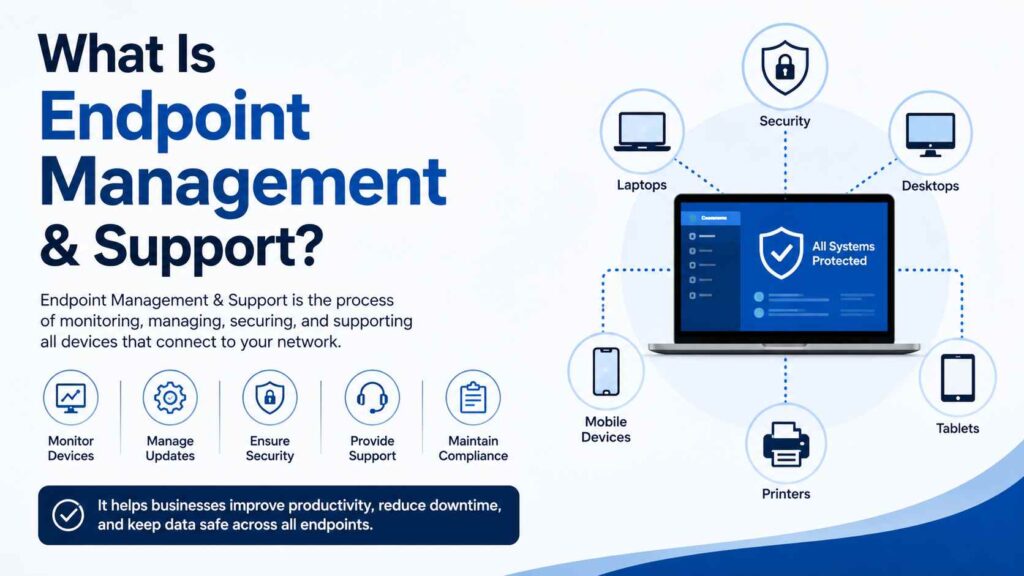
What Is Endpoint Management & Support? Think about your company network and how many devices touch it. Perhaps there is a company laptop that is used in the finance office. Maybe an employee uses a company phone to check company email from home. Maybe some of the salespeople carry company tablets. Perhaps there is a printer that a coworker left three years ago. Perhaps there is a long lost server that was never used. Every single one of these devices counts as a company doorway and where attackers look for access points in Manama, Riffa, Muharraq, and all other places in Bahrain. That’s the whole idea behind endpoint management, and it’s become one of those things businesses in Bahrain can’t really put off anymore. It used to be something only large enterprises worried about. Now, with how connected even a small office is, it’s relevant to almost everyone running a bank, a clinic, a school, or a government department, since the way you keep tabs on those devices often decides whether things run smoothly or whether you end up dealing with a breach nobody saw coming. What Is Endpoint Management, Really? Strip away the jargon and it comes down to this: finding, setting up, updating, securing, and watching every device that connects to your network. Those devices, laptops, phones, tablets, point-of-sale machines, even the odd IoT sensor in a hospital or factory, are called endpoints, hence the name. Instead of an IT person walking around to each machine individually, most companies now push updates and enforce rules from one dashboard, an approach usually called Unified Endpoint Management, or UEM, which has largely replaced the older setup where desktops and mobiles were handled by separate systems that didn’t talk to each other. For Bahraini companies, especially ones that shifted toward hybrid work after the pandemic, this stopped being a “nice extra” a while ago. A decade back, the conversation was mostly about antivirus software and firewalls. Today it’s about knowing, in real time, exactly what’s connected to your network, who’s using it, and whether it’s patched, encrypted, and compliant. Why Does It Matters More in Bahrain Than People Realize? Bahrain’s economy leans heavily on banking, government services, and healthcare — sectors that genuinely cannot afford downtime, let alone a data leak. The Central Bank of Bahrain doesn’t leave much room for guesswork here, so having visibility into every connected device isn’t optional if you’re in a regulated industry. Add to that the rise of hybrid work, common BYOD practices among smaller and mid-sized businesses, and a wider GCC region seeing more targeted cyberattacks, and it’s clear why waiting until something breaks is a gamble few local businesses can afford. Skip building a proper system and you end up reacting to problems instead of catching them early, which is a stressful and expensive way to run technology. A single missed patch management cycle, or one unflagged personal phone, can sit quietly as a risk for months. By the time it surfaces during an audit or an actual incident, fixing it costs far more than preventing it would have, which is exactly why more Bahraini organizations are shifting from reactive fixes toward something more deliberate and policy-driven. The Building Blocks There isn’t one magic tool that handles all of this. A decent endpoint management setup is really a handful of pieces working together, as shown below. Component What It Does Why It Matters in Bahrain Device Enrollment & Provisioning Sets up new laptops, phones, and tablets automatically Faster onboarding for new hires and branch offices Patch Management Rolls out software and OS updates remotely Closes gaps before someone exploits them Mobile Device Management (MDM) Secures phones and tablets used for work Keeps hybrid and field staff covered Access Control & Zero Trust Confirms identity before granting access Cuts risk from stolen credentials or lost phones Endpoint Security & Antivirus Catches malware and ransomware early Protects banking, healthcare, and government data Remote Monitoring & Support Flags issues before they become outages Less downtime for branch and remote teams Compliance Reporting Logs device activity for audits Meets Central Bank of Bahrain expectations None of these pieces work particularly well on their own. A patching tool without an accurate device inventory ends up missing machines, and access control without proper monitoring just creates a false sense of security. It’s the combination of all of them that actually holds up under pressure. What You Actually Get Out of It The benefits are fairly practical. Security incidents decrease as threats are identified prior to execution. Audits are simplified because logs and policy enforcement are provided. There are even more cost savings related to an escalation in site visits and manual troubleshooting. Additionally, staff enjoy the service more as devices break down less and are fixed more efficiently when they do. Long term benefits include easier device management. Adding a new branch in Bahrain doesn’t change the previous device management. There are even decreased costs, as we are able to manage device budgets better because we are able to foresee outdated devices. Finally, a compromised device is remotely isolated in under a minute rather than waiting for someone to locate the device. How Different Sectors in Bahrain Use It Banks and finance firms lean hard on device-level controls and real-time monitoring, mostly because regulators expect it, a lost laptop at a bank isn’t just an inconvenience, it can trigger a formal disclosure process depending on what was stored on it. Hospitals and clinics worry more about protecting patient files on shared workstations, since a device used across three nursing shifts a day needs different controls than a single employee’s laptop. Government offices need policies applied consistently across ministries and multiple locations, which sounds simple until you factor in the number of departments, contractors, and legacy systems usually involved. Schools juggle a mix of student and staff devices on tighter budgets, while retail and corporate offices mostly care about keeping point-of-sale systems and staff laptops running, since every minute
Data Center & Infrastructure Solutions in Bahrain

What is data center & Infrastructure solutions? Bahrain’s digital economy is growing faster than ever — banks, government ministries, healthcare providers, and enterprises are all racing to modernize their IT backbone while staying compliant with the Kingdom’s strict data regulations. At the center of that transformation sits one thing: the data center. At Nada Computer, we design, deploy, and manage data center and infrastructure solutions that are built specifically for Bahrain’s operating environment — its climate, its compliance requirements (CBB, government data residency rules), and the uptime expectations of enterprises that simply cannot afford downtime. This guide walks through everything that goes into a modern, resilient data center — from server deployment to power and cooling — so you know exactly what to look for, whether you’re building from scratch, upgrading an existing setup, or evaluating a provider. Why Bahrain Businesses Need a Local Data Center Partner Unlike generic international vendors, a Bahrain-based infrastructure partner understands: Local compliance — Central Bank of Bahrain (CBB) requirements for financial institutions, and government data residency rules that often require data to stay within the Kingdom. Climate-specific engineering — Bahrain’s heat and humidity directly affect cooling design, redundancy planning, and equipment lifespan. On-ground support — 24/7 monitoring only works if there’s a real engineer who can reach your site the same day, not a call center overseas. Nada Computer has been delivering IT infrastructure across Manama, Seef, Riffa, Muharraq, Hamad Town, and the industrial zones of Sitra and Hidd since 2008 — which means every recommendation below is grounded in real deployments, not theory. 1. Server Deployment & Virtualization A data center is only as strong as the servers running inside it. We deploy and configure: Dell PowerEdge servers and other enterprise-grade hardware, sized correctly for your workload instead of over- or under-provisioned VMware and Microsoft Hyper-V virtualization, consolidating physical servers into efficient virtual environments that cut hardware costs and simplify management Physical-to-virtual (P2V) migrations for organizations modernizing legacy infrastructure without disrupting operations The goal isn’t just “install a server” — it’s building an environment that can scale as your business grows, without a forklift upgrade every two years. 2. Storage Solutions & RAID Configuration Data loss from a single failed drive should never be a possibility. Our storage architecture includes: RAID-configured storage arrays (RAID 1, 5, 6, 10 depending on the workload) for redundancy and performance NAS and SAN storage design for centralized, high-availability data access Storage scaling plans so capacity grows with your data instead of requiring emergency expansion projects A well-designed storage layer means hardware failure becomes a non-event — the system keeps running while the faulty component is replaced. 3. Power, Cooling & Redundancy — The Part Most Providers Get Wrong This is where a lot of data center projects in Bahrain fail — not because of bad servers, but because of underbuilt power and cooling. Heat is the single biggest threat to uptime in this climate, and it’s often the most under-engineered part of a local deployment. A properly built environment includes: Redundant power supplies (N+1 or 2N) so a single power failure never takes systems offline UPS integration to bridge the gap between a power cut and generator activation Automatic backup generators for extended outages Precision cooling design — sized for Bahrain’s ambient heat, not a generic international spec sheet PUE-conscious design (Power Usage Effectiveness) — the more efficient your cooling, the lower your operating cost over the server’s lifetime Fire detection and suppression systems integrated into the rack and room design from day one, not bolted on afterward Redundancy isn’t a luxury add-on — for banks, hospitals, and government systems, it’s the difference between “we had an incident” and “nobody even noticed.” 4. Data Center Design & Rack Setup Whether you’re building a full server room or optimizing an existing one, proper design covers: Space and airflow planning — hot-aisle/cold-aisle layouts that keep cooling efficient instead of fighting itself Structured rack and cabinet installation with organized, labeled cabling (the difference between a 10-minute fix and a 3-hour outage during troubleshooting) Scalable layouts that leave room for future racks instead of requiring a redesign at 80% capacity Compact and modular server room options for businesses that need infrastructure fast without a full construction project — useful for branch offices, edge locations, or organizations expanding across the GCCGood rack design is invisible when everything works — and invaluable the one time it doesn’t. Data Center Tier Classification Tier Redundancy Level Uptime Guarantee Annual Downtime Best Suited For Tier I No redundancy 99.671% ~28.8 hours Small offices, non-critical systems Tier II Partial redundancy 99.741% ~22 hours SMEs, moderate uptime needs Tier III N+1, concurrently maintainable 99.982% ~1.6 hours Banks, enterprises, government systems Tier IV 2N, fully fault-tolerant 99.995% ~26 minutes Critical national infrastructure, large financial institutions 5. Backup & Disaster Recovery Planning Every data center strategy needs an answer to one question: “What happens if this entire facility goes down?” Our backup and disaster recovery planning includes: Automated, scheduled backups — not manual processes that get forgotten Offsite and cloud-based backup options to protect against site-level incidents Recovery time objective (RTO) and recovery point objective (RPO) planning, so you know exactly how fast you’re back online and how much data (if any) you could lose Regular recovery testing — a backup that’s never been tested to restore is a backup you can’t trust Disaster recovery isn’t just for worst-case scenarios anymore — ransomware, hardware failure, and human error make it a when, not an if. 6. Compliance for Regulated Industries in Bahrain Banks, government bodies, and healthcare providers face compliance obligations most standard IT vendors aren’t equipped to handle: Data residency — keeping sensitive data physically within Bahrain when required by regulators CBB-aligned infrastructure practices for financial institutions Access control, audit logging, and monitoring built into the infrastructure layer, not added as an afterthought Documentation and reporting ready for regulatory review, not scrambled together during an audit This is where a lot of generic IT providers fall short —
Best Annual Maintenance Contracts In Bahrain

Do you ant to know about best annual maintenance contracts In bahrain? Businesses needs their buildings, tools, IT, power infrastructure, and others to run their operations each work day. Equipment breakdowns interrupt operations; they also impact employees and customers, incur expense to repair unexpected breakdowns, and become cost centers. Annual Maintenance Contracts (AMC) answer equipment breakdown related challenges that businesses face in Bahrain. An AMC is a business service maintenance contract for scheduled equipment servicing, equipment inspection, equipment repairs, and maintenance service support for a contract term interval. There are maintenance service providers in the market that provide AMCs for business IT equipment, air conditioning, electrical systems, plumbing, machinery, servers, networks, and CCTV systems, among others. AMC service contracts in Bahrain that companies are looking for should not just have the ability to respond to service requests for breakdown maintenance. A well thought AMC should provide proactive maintenance and enable the business to identify and address issues before equipment breakdown. What Is an Annual Maintenance Contract? An Annual Maintenance Contract is a service agreement that takes care of the maintenance of equipment, systems, or property over a period of one year. Businesses choose to have a maintenance provider under a maintenance contract as opposed to calling a technician every time a problem arises. Some contracts include regular check-ups, routine maintenance, some degree of fixing, on-site visits, calls for tech support, and report generation. The coverage provided under the contract varies. Some providers specialize in maintenance of IT equipment, while others specialize in building, HVAC, plumbing, electrical, and industrial equipment. For example, an IT-focused AMC may include server monitoring, network support and maintenance, computer support, security updates and on-site support. A property focused AMC may include support and maintenance for the plumbing, electrical, and drains, and may include carpentry, painting and building maintenance. Competitor offerings in Bahrain illustrate this point best. Why Do Businesses in Bahrain Need AMC Services? Bahrain businesses operate with equipment and facilities that require regular attention. Waiting until a system fails can lead to higher repair bills and longer downtime. A properly managed AMC provides a planned approach to maintenance. Instead of relying entirely on reactive repairs, technicians inspect equipment and systems according to an agreed schedule The main advantages include Reduced unexpected breakdowns Better equipment performance Planned maintenance costs Faster response to urgent problems Longer equipment life Regular inspections and servicing Access to trained technicians Better maintenance records Reduced operational downtime Easier budgeting for maintenance An AMC can also make responsibilities clearer. The contract should state which assets are covered, how often technicians visit, what type of repairs are included, and which expenses remain the customer’s responsibility. What Services Can an Annual Maintenance Contract Include? There is no single AMC package that suits every company. Coverage should match the equipment, property, business requirements, and level of support needed. IT Equipment Maintenance IT AMC services can cover desktops, laptops, printers, servers, storage devices, and other office equipment. Common services include: Hardware inspection Computer troubleshooting Laptop maintenance Printer support Server maintenance Software troubleshooting Performance checks Operating system updates Security patch management Data backup assistance 2. Network and Server Support A network problem can affect an entire office rather than a single employee. For this reason, companies with important IT infrastructure may include network equipment and servers in their AMC. Network AMC services can cover switches, routers, access points, firewalls, wireless connections, and related infrastructure. Server support may include routine health checks, monitoring, troubleshooting, updates, backup checks, and performance reviews. 3. CCTV and Security Systems Businesses often depend on CCTV and electronic security systems to protect their premises. An AMC can include CCTV camera inspection Recording system checks Network camera troubleshooting Storage checks Access control support System testing Fault diagnosis 4. HVAC and Air Conditioning Maintenance Air conditioning in Bahrain’s commercial properties is a necessity, and regular HVAC maintenance helps minimize the chance of major equipment failures. Preventative work may include the inspection of equipment, cleaning or removal of dirt, cobwebs, dust and other foreign elements from filters, cleaning of coils, testing and adjustment of electrical and refrigerant circuits, and testing and evaluating the performance of a system. An example of a Bahraini government tender for HVAC maintenance indicates that the required AMC scope will include recurring preventive maintenance, major services and annual services, delivery of spare parts, emergency calls, and the provision of labor. 5. Electrical Maintenance Electrical systems require regular inspection because faults can affect business continuity and equipment safety. Depending on the agreement, electrical maintenance may cover Distribution boards Switches and sockets Lighting Electrical connections Earthing Power-related equipment Generator systems UPS systems 6. Plumbing and Building Maintenance Property-based AMC packages may include plumbing, drainage, carpentry, painting, and other building maintenance tasks. Common plumbing services include leak detection, water heater checks, pump maintenance, drainage work, and pipe repairs. A good contract should clearly identify whether labor, tools, consumables, and spare parts are included or charged separately. What Services Can an Annual Maintenance Contract Include? AMC Service What It Covers Best For IT AMC Bahrain Computers, laptops, printers, software and technical troubleshooting Offices and businesses Server Maintenance Server monitoring, health checks, updates, backups and troubleshooting Companies with in-house servers Network Maintenance Routers, switches, access points, connectivity and network troubleshooting Offices and commercial sites CCTV AMC Camera inspection, recording systems, storage and fault diagnosis Offices, shops and commercial properties HVAC Maintenance AC inspection, cleaning, performance checks and preventive servicing Offices, buildings and facilities Electrical Maintenance Lighting, switches, electrical connections, distribution boards and related systems Commercial properties Plumbing Maintenance Leak detection, drainage, pumps, pipes and water-related repairs Buildings and businesses Hardware AMC Services Maintenance and repair of desktops, laptops, printers and other hardware Small and medium businesses Preventive Maintenance Regular inspections and servicing to identify issues before breakdowns All types of businesses Emergency Maintenance Breakdown response and urgent technical assistance Businesses requiring fast support Facility Management Services General building, electrical, plumbing, HVAC and maintenance support Commercial properties Annual Maintenance Contract Services in Bahrain Customized yearly maintenance covering selected equipment
Cloud Migration Bahrain:Nada Computer’s Expert Guide

Our team at Nada Computer has run cloud migration projects for government departments and healthcare providers across Bahrain for years now, and we’ve noticed something every single time: the client rarely fears the technology itself. They fear the moment nobody warned them about — the compliance question they didn’t ask early enough, the data residency clause they skimmed past, the rollback plan that turned out to exist only on paper. We wrote this guide to close that gap. We’ll walk you through what a cloud migration Bahrain project actually requires when the data involved carries real legal and ethical weight, share what we’ve seen go right, what we’ve seen go wrong, and give you a practical way to evaluate any provider you’re considering, including us. We Define Migration the Way We Actually Run It, Not the Way Vendors Pitch It Vendors love to describe migration as a single event, a weekend cutover, a “big switch,” done and dusted by Monday morning. We don’t run projects that way, and honestly, we’d question any provider who pitches it that way to you. We define migration as a phased relocation, not the single-weekend event vendors love to pitch when they’re trying to close Cloud Migration Bahrain deal quickly. We move low-risk systems first, test the process, learn from what we find, then move more sensitive systems once we’ve proven the approach actually holds. Some systems, frankly, we recommend clients leave exactly where they are, because moving them adds risk without adding real benefit. We say that even when it means a smaller contract, because we’d rather keep a client’s trust than pad out a scope. Why We Treat Government and Healthcare Projects Differently From Day One We’ve run migrations for retail businesses and we’ve run them for hospitals, and we can tell you directly: the stakes aren’t remotely comparable. A retail inventory system going briefly offline costs money and annoys customers. A hospital records system handled poorly carries consequences that go far beyond inconvenience. We build healthcare data cloud security into our planning from the very first meeting, not as a phase we add later. That means we map exactly who needs access to what, we design encryption and identity controls before we touch a single server, and we build audit trails that can answer, months later, exactly who accessed what and when. Government clients get the same treatment, layered with additional questions we insist on answering upfront: where does this data physically sit, and which country’s laws actually govern it once it’s there? We Ask the Sovereignty Question Before We Ask Anything Else Most providers save this question for the contract’s fine print, if they address it at all. We ask it first, because we’ve seen what happens when organizations skip it: a provider’s servers sit outside the region, a foreign legal request theoretically compels access to that data, and nobody at the client organization even knew that risk existed until it became a live problem. Data sovereignty Bahrain clients need clarity on isn’t optional homework, we treat it as a non-negotiable first step. We verify exactly where a provider’s infrastructure physically sits, whether region-specific hosting within Bahrain or the GCC is available, and we put the answer in writing before recommending anything to a client. If a provider dodges that question or gives us a vague answer, we tell our clients to walk away, regardless of how attractive the pricing looks. Five Things We Insist on Getting Right, Every Single Time We’ve reviewed migration plans other providers built for prospective clients, and the same gap shows up constantly: a solid technical plan with compliance tacked on as an afterthought. We don’t work that way. We treat these five pillars as equally important from the very first planning session. Pillar What We Actually Do Why We Refuse to Skip It Data Classification We catalogue and categorize every dataset before touching anything We can’t protect what we haven’t properly identified Security Architecture We design encryption, access scoping, and identity management upfront Retrofitting security after migration multiplies the risk Compliance Mapping We match the plan to Bahrain’s specific regulatory expectations Government and healthcare face obligations most vendors overlook Downtime Planning We schedule moves strictly around critical service hours We won’t let a hospital system go dark during peak hours Rollback Strategy We test a genuine reverse path before we ever migrate live data We need a real safety net, not a hopeful assumption We Bring Compliance Into the Room First, Not Last We’ve watched other migrations stall for months because the technical team picked a provider and locked in an architecture before anyone consulted legal or compliance. By the time someone finally raised a regulatory concern, unwinding the technical decisions already made cost far more time and money than addressing it upfront would have. We handle cloud compliance government entities require by pulling legal and compliance stakeholders into our very first planning meeting, not the fourth one. We map data residency requirements, access auditing obligations, and approval processes before we design a single piece of architecture. This slows down the first few weeks of a project. It saves months later, and every client we’ve worked with this way has told us it was worth the extra upfront time. We Choose Between Public, Private, and Hybrid Based on Evidence, Not Trends We don’t default to whatever cloud model is trending. We assess each client’s actual data, actual regulatory obligations, and actual risk tolerance, then recommend the model that fits — even when it’s the less exciting, less “cutting-edge” option. Model What It Means When We Recommend It Public Cloud Shared infrastructure managed by a major provider Lower-sensitivity, scalable workloads Private Cloud Dedicated infrastructure built for one organization Highly sensitive data under strict regulatory demands Hybrid Cloud Sensitive data stays private, less critical workloads go public Most of our government and healthcare clients land here We build hybrid cloud solutions Bahrain clients trust because it reflects how sensitive-sector organizations actually operate. We keep a hospital’s patient
Top 10 SEO Services For Bahrain

Do you want to know top 10 SEO Services for Bahrain? I’ve sat in enough meetings with Bahraini business owners to know how this conversation usually starts. Someone mentions “we should probably do SEO,” everyone nods, and then nothing happens for another six months. Not because they don’t care, because nobody in the room actually knows what SEO involves beyond the buzzword. So let’s fix that here. If you run a business in Bahrain and your website barely shows up when people search Google, this is for you. No fluff, no recycled definitions copied from a hundred other agency pages. Just what SEO actually is, why it matters here specifically, and what a sensible plan looks like if you’re serious about ranking. Let’s Start With What SEO Actually Is Forget the textbook definition for a second. Here’s the plain version: Google has to decide, out of millions of websites, which ten show up on the first page for any given search. SEO is everything you do to convince Google your site deserves to be one of them. That’s it. It’s not magic, and it’s not a switch you flip. SEO services Bahrain businesses hire agencies for usually break down into a few honest components, cleaning up your website so search engines can actually read it properly, writing content that answers what people are genuinely searching for, and building enough credibility online that Google trusts you over the next guy. Compare that to paid ads. The second you stop paying, your traffic disappears — I’ve watched it happen to clients literally the week their ad budget ran out. SEO doesn’t work that way. Once you’ve earned a ranking, it tends to stick around, quietly bringing in traffic long after you’ve stopped actively “working” on that particular page. That’s the whole appeal of putting real effort into digital marketing Bahrain teams treat as a long game rather than a quick campaign. Why Bahrain Specifically Is a Bit Different Here’s something most generic SEO advice online won’t tell you: Bahrain is a small, tightly connected market. Nearly everyone here has a smartphone, and nearly every purchase decision — from picking a dentist to hiring an IT vendor — starts with a Google search rather than a Yellow Pages flip or a billboard glance. What surprised me the first time I actually dug into this market: a huge number of Bahraini businesses simply haven’t bothered with SEO yet. Their websites exist, sure, but nobody’s touched the meta tags since 2019, and their Google Business listing has three photos and no reviews. That’s not a criticism, it’s genuinely good news if you’re reading this, because it means the bar to stand out isn’t nearly as high as people assume. You don’t need to out-SEO a hundred aggressive competitors. You mostly need to out-SEO the handful who bothered to show up at all, and once your website ranking Google position is established, it tends to hold, simply because so few others are actively contesting it. Top 10 SEO Services for Bahrain # Company Website Specialty 1 Nada Computer nadacomputers.com Full-service IT + Digital Solutions (SEO, social media, web/app dev) integrated with cybersecurity & network infra — Bahrain based since 2008 2 Finsoul Bahrain fin-soul.com/seo-services-bahrain Full-service SEO (technical, local, content, e-commerce) — most comprehensive content depth 3 Invent ITS invent-its.com/en/seo-services-bahrain-gcc SEO + ERP/business software combo, GCC-wide focus 4 ThatWare thatware.co/seo-services-bahrain AI-driven SEO, LLM SEO, AEO/GEO (answer engine optimization) 5 AGS (Auxano Global Services) auxanoglobalservices.com/bahrain-seo Google Premier Partner, 10+ years experience 6 GO-Globe go-globe.com/bahrain/seo-bahrain.php Award-winning web agency, 20 years experience, Dubai-based with Bahrain service 7 Bytes Future (via 10Seos listing) Full digital marketing — SEO, social media, video, web dev 8 Crayo Tech Bahrain crayotech.com Software + SEO/SEM/SMO combo, Bahrain & KSA 9 Webtree Media Solutions (Bahrain-based) Subsidiary of Arabian International Services Co., full digital marketing 10 Brandstory brandstory.ae/bahrain/seo-services Google Penalty Recovery specialist, technical SEO audits Is This Actually Worth It If You’re a Small Business? Short answer: probably more than for the big guys. Large companies can throw money at ads and brand recognition to compensate for weak SEO. Smaller businesses can’t always do that, which is exactly why SEO tends to be the highest-leverage thing a smaller operation can invest in. SEO for small business Bahrain owners run isn’t about outspending anyone, it’s about being smarter and more consistent than the competition, which frankly isn’t that hard when most of the competition isn’t doing much at all. You should probably be paying attention to this if any of these sound familiar People visit your site, but almost none of them arrive from a Google search A competitor you know is objectively worse than you somehow ranks above you You’re starting fresh and want visibility from day one, not two years from now You’re tired of paying for every single click through ads You want to dominate searches from people specifically in your part of Bahrain Referrals used to be enough, but that’s clearly not cutting it anymore The Actual Pieces That Make Up SEO People throw the word “SEO” around like it’s one task. It isn’t. It’s a handful of different jobs that happen to overlap. SEO Component What’s Actually Involved Why You Should Care Technical SEO Site speed, mobile behavior, broken links, how cleanly the site is built If Google can’t crawl your site properly, nothing else here matters On-Page SEO Where keywords go, how titles and headings are written, internal links Tells Google (and readers) exactly what a page is actually about Off-Page SEO Other credible sites linking back to you This is basically Google’s version of a reference check Local SEO Google Business Profile, local listings, “near me” targeting For most Bahraini businesses, this is where the fastest wins hide Content SEO Blog posts and pages built around what people actually search The part that keeps compounding long after you’ve published it Local SEO Deserves Its Own Section, Honestly If I had to tell a Bahraini business owner where to put their