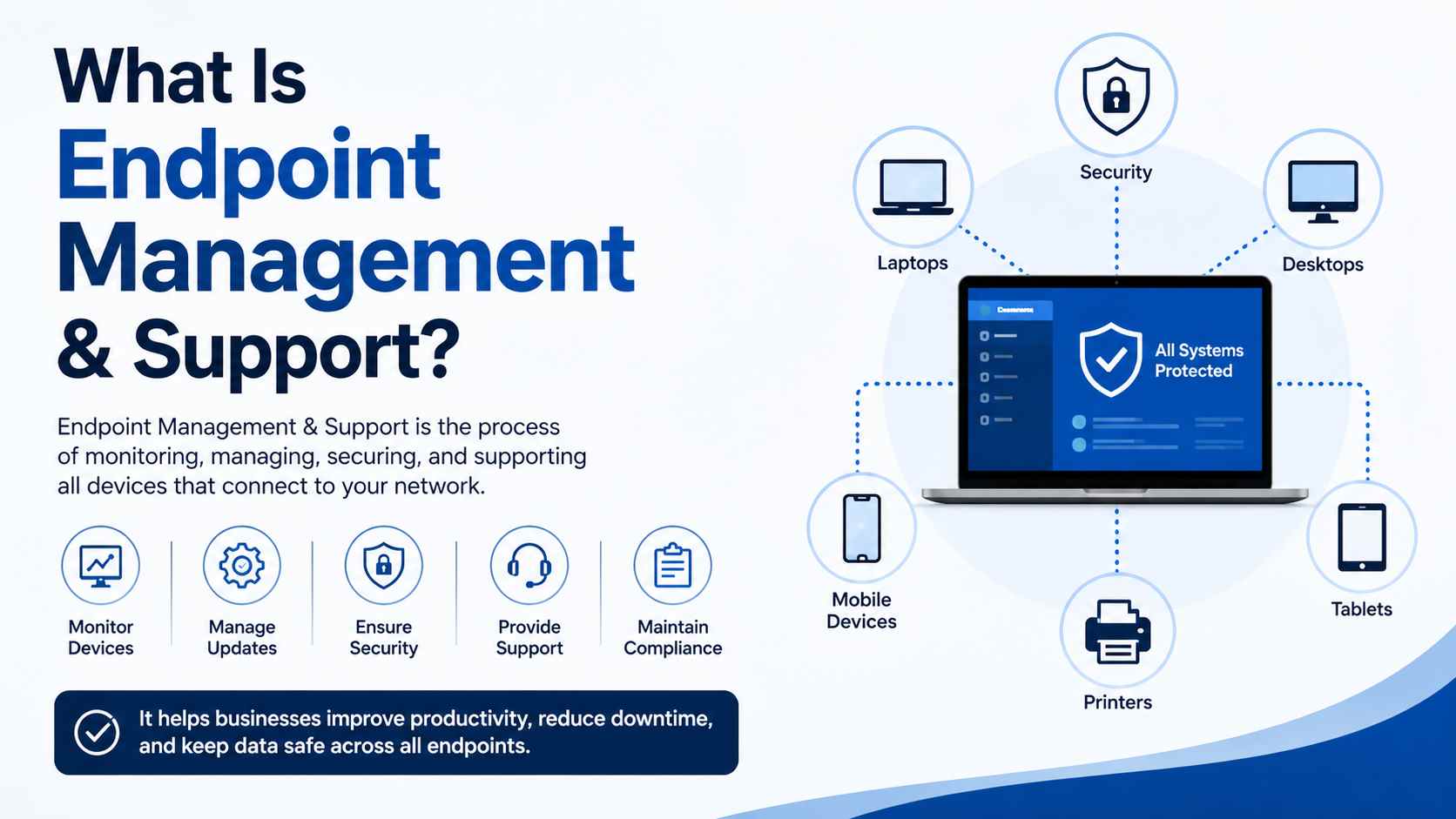
What Is Endpoint Management & Support? Think about your company network and how many devices touch it. Perhaps there is a company laptop that is used in the finance office. Maybe an employee uses a company phone to check company email from home. Maybe some of the salespeople carry company tablets. Perhaps there is a printer that a coworker left three years ago. Perhaps there is a long lost server that was never used. Every single one of these devices counts as a company doorway and where attackers look for access points in Manama, Riffa, Muharraq, and all other places in Bahrain.
That’s the whole idea behind endpoint management, and it’s become one of those things businesses in Bahrain can’t really put off anymore. It used to be something only large enterprises worried about. Now, with how connected even a small office is, it’s relevant to almost everyone running a bank, a clinic, a school, or a government department, since the way you keep tabs on those devices often decides whether things run smoothly or whether you end up dealing with a breach nobody saw coming.
What Is Endpoint Management, Really?
Strip away the jargon and it comes down to this: finding, setting up, updating, securing, and watching every device that connects to your network. Those devices, laptops, phones, tablets, point-of-sale machines, even the odd IoT sensor in a hospital or factory, are called endpoints, hence the name. Instead of an IT person walking around to each machine individually, most companies now push updates and enforce rules from one dashboard, an approach usually called Unified Endpoint Management, or UEM, which has largely replaced the older setup where desktops and mobiles were handled by separate systems that didn’t talk to each other.
For Bahraini companies, especially ones that shifted toward hybrid work after the pandemic, this stopped being a “nice extra” a while ago. A decade back, the conversation was mostly about antivirus software and firewalls. Today it’s about knowing, in real time, exactly what’s connected to your network, who’s using it, and whether it’s patched, encrypted, and compliant.
Why Does It Matters More in Bahrain Than People Realize?
Bahrain’s economy leans heavily on banking, government services, and healthcare — sectors that genuinely cannot afford downtime, let alone a data leak. The Central Bank of Bahrain doesn’t leave much room for guesswork here, so having visibility into every connected device isn’t optional if you’re in a regulated industry. Add to that the rise of hybrid work, common BYOD practices among smaller and mid-sized businesses, and a wider GCC region seeing more targeted cyberattacks, and it’s clear why waiting until something breaks is a gamble few local businesses can afford.
Skip building a proper system and you end up reacting to problems instead of catching them early, which is a stressful and expensive way to run technology. A single missed patch management cycle, or one unflagged personal phone, can sit quietly as a risk for months. By the time it surfaces during an audit or an actual incident, fixing it costs far more than preventing it would have, which is exactly why more Bahraini organizations are shifting from reactive fixes toward something more deliberate and policy-driven.
The Building Blocks
There isn’t one magic tool that handles all of this. A decent endpoint management setup is really a handful of pieces working together, as shown below.
| Component | What It Does | Why It Matters in Bahrain |
| Device Enrollment & Provisioning | Sets up new laptops, phones, and tablets automatically | Faster onboarding for new hires and branch offices |
| Patch Management | Rolls out software and OS updates remotely | Closes gaps before someone exploits them |
| Mobile Device Management (MDM) | Secures phones and tablets used for work | Keeps hybrid and field staff covered |
| Access Control & Zero Trust | Confirms identity before granting access | Cuts risk from stolen credentials or lost phones |
| Endpoint Security & Antivirus | Catches malware and ransomware early | Protects banking, healthcare, and government data |
| Remote Monitoring & Support | Flags issues before they become outages | Less downtime for branch and remote teams |
| Compliance Reporting | Logs device activity for audits | Meets Central Bank of Bahrain expectations |
None of these pieces work particularly well on their own. A patching tool without an accurate device inventory ends up missing machines, and access control without proper monitoring just creates a false sense of security. It’s the combination of all of them that actually holds up under pressure.
What You Actually Get Out of It
The benefits are fairly practical. Security incidents decrease as threats are identified prior to execution. Audits are simplified because logs and policy enforcement are provided. There are even more cost savings related to an escalation in site visits and manual troubleshooting. Additionally, staff enjoy the service more as devices break down less and are fixed more efficiently when they do.
Long term benefits include easier device management. Adding a new branch in Bahrain doesn’t change the previous device management. There are even decreased costs, as we are able to manage device budgets better because we are able to foresee outdated devices. Finally, a compromised device is remotely isolated in under a minute rather than waiting for someone to locate the device.
How Different Sectors in Bahrain Use It
Banks and finance firms lean hard on device-level controls and real-time monitoring, mostly because regulators expect it, a lost laptop at a bank isn’t just an inconvenience, it can trigger a formal disclosure process depending on what was stored on it. Hospitals and clinics worry more about protecting patient files on shared workstations, since a device used across three nursing shifts a day needs different controls than a single employee’s laptop.
Government offices need policies applied consistently across ministries and multiple locations, which sounds simple until you factor in the number of departments, contractors, and legacy systems usually involved. Schools juggle a mix of student and staff devices on tighter budgets, while retail and corporate offices mostly care about keeping point-of-sale systems and staff laptops running, since every minute a till is down is a minute of lost revenue. The tools involved often overlap across these sectors, but the priorities rarely do, which is why a one-size-fits-all setup usually falls short once an organization grows.
What Goes Wrong Without One
Companies that put this off tend to run into the same handful of problems: shadow devices nobody’s tracking, patches that sit unapplied for months, security policies that differ from one department to the next, and no visibility when something actually breaks. In regulated industries, that isn’t just inconvenient — it can mean failed audits or fines.
BYOD enforcement is usually the weakest link in this picture. When employees connect personal phones to company email without any real oversight, IT loses track of what’s being accessed and from where, and that gap is hard to close after the fact. It’s exactly why more Bahraini businesses are leaning toward a zero trust approach, checking every user and device before granting access rather than assuming anything inside the network is automatically safe.
Cloud-Based vs. On-Premise Approaches
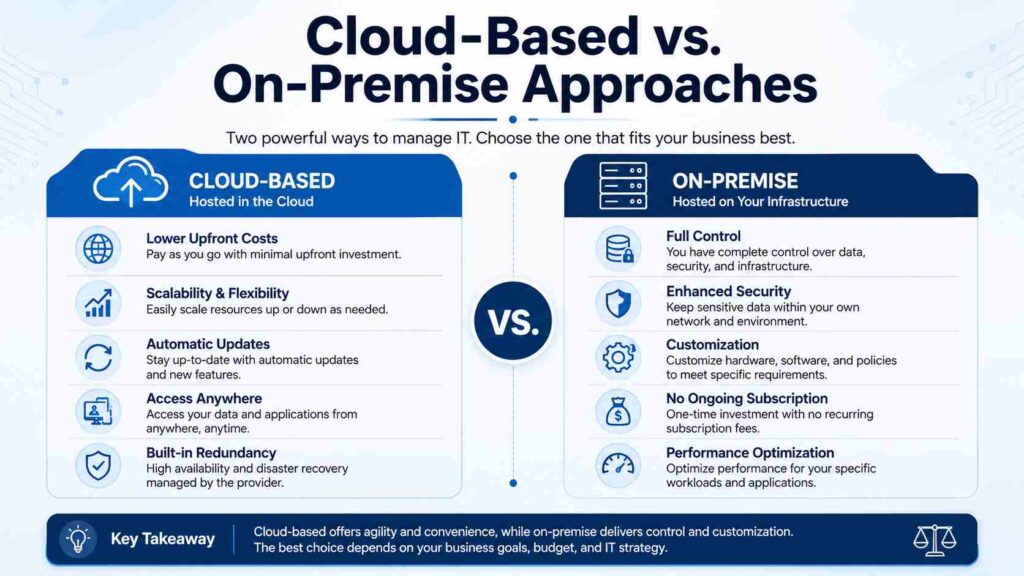
Bahraini businesses generally choose between two broad approaches, and the right one depends on company size, regulatory obligations, and existing infrastructure. Cloud-based endpoint management runs through a vendor’s hosted platform, is usually faster to deploy, and scales easily as a company adds branches or staff, making it a practical route for mid-sized companies without a large in-house IT team.
On-premise setups keep everything hosted within the organization’s own infrastructure, which appeals to banks, government bodies, and healthcare providers needing tighter control over where data physically resides, particularly given Bahrain’s data residency expectations for regulated sectors. Many organizations settle somewhere in between, keeping sensitive data on-premise while using cloud tools for day-to-day tasks that don’t touch regulated information.
A Practical Roadmap for Getting Started
For a Bahraini business starting from scratch, the process usually begins with a full inventory of every device connecting to the network, including the ones IT doesn’t officially know about, since you can’t manage what you can’t see. From there, devices get classified by risk, a finance director’s laptop clearly doesn’t need the same scrutiny as a lobby kiosk, and baseline policies around patching, passwords, and access get set before any tool is deployed.
Once the groundwork is laid, choosing between a cloud UEM platform or an on-premise setup comes down to the factors discussed earlier. Rolling out in phases, starting with one department or branch, avoids the chaos of a company-wide rollout going wrong all at once, and the first few months usually reveal gaps in the original plan — which is normal, since the goal is ongoing refinement rather than getting it perfect on day one.
Picking the Right Provider in Bahrain
There are a few practical questions you should ask yourself before signing with a service provider. For example, you should assess if the service provider is based in Bahrain and fits the expectations of Central Bank. You should also assess if the service provider actively monitors their systems and if they have previous experience working with clients in your sector; this is very important. It is also important to assess if the service provider offers an all-in-one solution and if they are able to comply with the requirement to store data in Bahrain.
Nada Computer, based in Manama, works with enterprises, banks, and government and healthcare services in Bahrain, since 2008. Nada Computer has built a structured process from consultations to deployments and is supported by technical staff. When organizations wish to review their current situation, they can consider Nada Computer’s End Point Management & Support service.
Bottom Line
Bahrain’s businesses aren’t slowing down on hybrid work, mobile tools, or cloud adoption anytime soon, and that means more devices touching sensitive systems every year. Proper endpoint management isn’t optional anymore for anyone handling regulated data or trying to avoid expensive downtime, it’s become one of the baseline requirements for staying operational, let alone competitive. Working with a provider that actually understands Bahrain’s rules, not just the technology, makes that process far less painful as a business grows, and the businesses that get ahead of it usually spend a lot less time cleaning up after problems later on.
FAQs
Isn’t endpoint security the same thing?
Not quite. Antivirus and threat detection are one piece of it. The bigger picture also covers provisioning, patching, monitoring, and policy across a device’s entire life, not just blocking malware.
Do small businesses in Bahrain really need this?
Even a ten-person office benefits, especially if staff use their own phones or work remotely a couple days a week.
How does UEM fit into all this?
Unified Endpoint Management is basically the modern version — one platform handling desktops, mobiles, and everything else, instead of separate tools for each device type.
Does this help with Bahrain’s compliance rules?
Yes. It generates the audit trails and access logs that the Central Bank of Bahrain and similar bodies usually want to see from finance and healthcare organizations.
How often should patches go out?
As soon as they’re released, ideally, since manual scheduling tends to leave gaps that automated patch tools are meant to close.
How long does it take to set up properly?
It depends on how many devices and how messy the current setup is, but most Bahraini businesses can get the basics running within a few weeks once a provider maps out the existing environment.