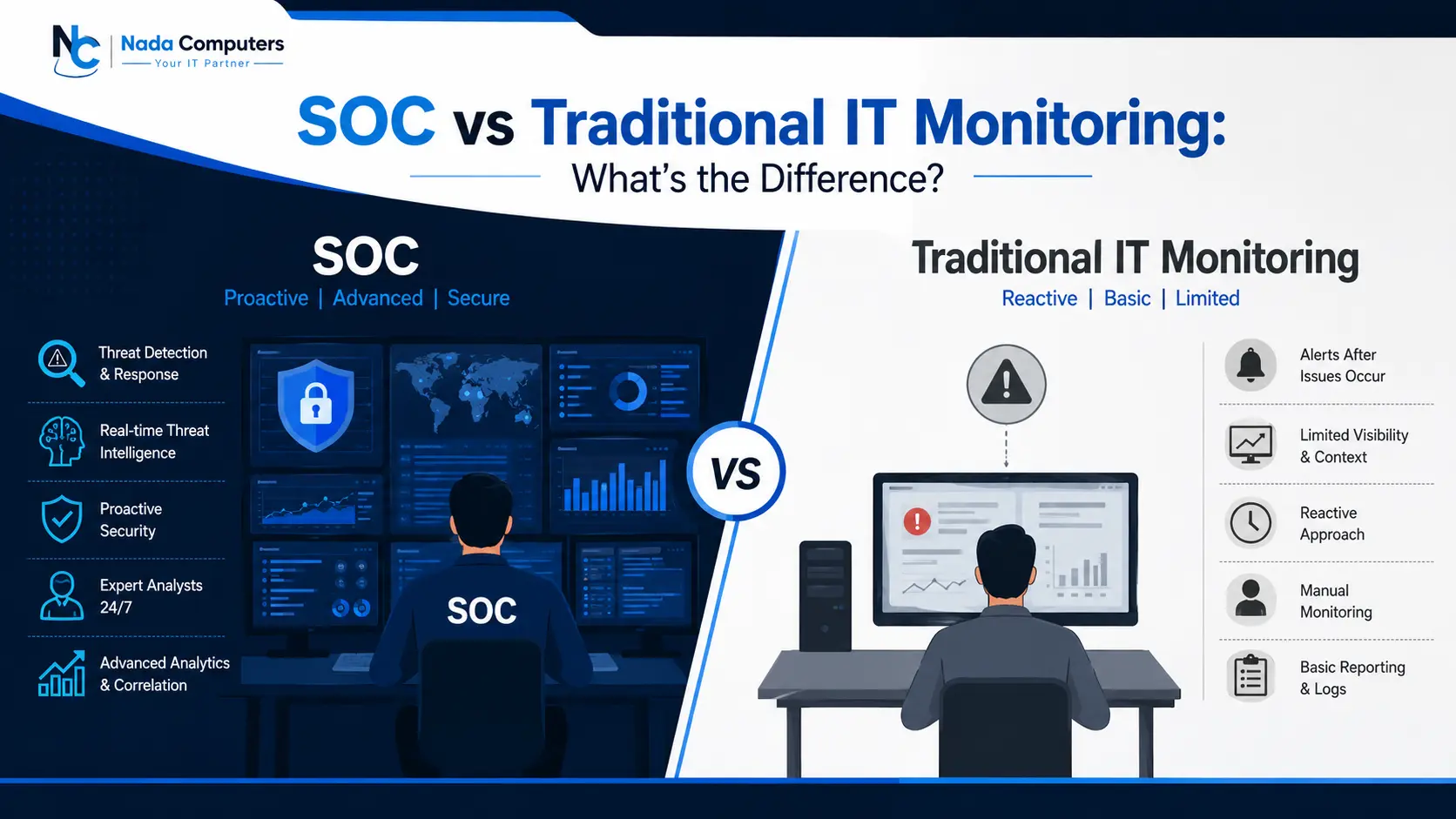
Do you know about SOC vs traditional IT monitoring? Ask an IT manager in Manama what “monitoring” meant ten years ago and you get the same answer. A screen showed whether the servers were up, whether the internet link was alive, and whether last night’s backup finished. If something turned red, someone raised a ticket. That worked, because most problems then were mechanical, a failed disk, an overloaded switch, a link that dropped in a storm.
Attacks have moved on. A modern intrusion rarely knocks anything over. It borrows a valid username, logs in during working hours from a plausible location, reads a few mailboxes, then copies data out over an encrypted connection that looks like ordinary web traffic. Nothing crashes. No alert fires. Uptime stays at 100%.
That is the uncomfortable part: your network can look perfectly healthy on every dashboard you own while somebody is already inside it. This article explains what traditional monitoring actually does, what a Security Operations Center does differently, and how to judge which one your business in Bahrain needs.
What is Traditional IT Monitoring?
Traditional IT monitoring is health monitoring. Its job is to tell you whether your technology is working — not whether it is safe.
How it works
Most setups follow the same pattern. Agents sit on servers and workstations, network devices are polled using SNMP, and thresholds are set: alert if a disk passes 85% capacity, alert if a server stops responding for two minutes, alert if CPU stays above 90%. When a threshold breaks, the system emails the IT team or opens a ticket.
It handles a defined list of questions well:
- Is the server online?
- Is there enough disk space and memory?
- Did the backup job complete?
- Is the internet link saturated?
- Are printers, switches and access points responding?
For availability, this is genuinely useful. Nada Computers uses the same discipline inside our own Managed IT Services — you cannot secure infrastructure you are not measuring.
Where it stops
The gap appears the moment the question changes from “is it working?” to “is somebody abusing it?”
- It measures availability, not intent. A file server copying 40 GB to an unknown external address is still a healthy file server as far as the dashboard is concerned.
- It watches devices in isolation. One failed login means nothing. The same failed login across nineteen accounts in four minutes is a password-spraying attack — but only if something compares those events to each other.
- It effectively runs on office hours. The tool watches all night; the person who reads the alert arrives at 8 AM.
- It produces noise. When almost every alert is harmless, staff learn to skim — and the one that mattered gets skimmed too.
- It rarely keeps useful logs. After an incident, most companies find seven days of performance data and no authentication history at all.
- It does not respond. It informs. Somebody still has to interpret, decide and act.
A familiar scenario
A retail group in Seef ran a solid monitoring stack across four branches. A finance employee opened an invoice attachment that installed a credential stealer. Over eleven days, the attacker logged into the accounts mailbox with the stolen password, created a rule to hide replies, and altered supplier bank details on two outgoing payments.
Every server stayed green. Uptime for the month was 99.98%. The loss was found by the supplier, not the IT team — because nothing had broken, and health monitoring only reports things that break.
What is a Security Operations Center (SOC)?
A Security Operations Center is a team of security specialists, supported by detection technology and defined procedures, whose only job is to watch for signs of attack and act on them.
The simplest way to picture it: traditional monitoring is the building management system tracking lifts, air conditioning and lighting. A SOC is the control room where trained officers watch the cameras, recognise behaviour that does not belong, and send someone to intervene.
Round-the-clock coverage
A SOC runs on shift rotations, so a qualified analyst is always watching — 3 AM on a Tuesday, the second Friday of Ramadan, the morning of Eid. Attackers deliberately choose the hours when nobody is looking, which is why coverage cannot follow office timings.
Detection built on behaviour
Instead of waiting for a threshold to break, a SOC hunts for patterns that suggest an intruder: impossible travel between logins, a service account suddenly browsing file shares, PowerShell launching from a Word document, admin rights granted outside the change window, backups deleted just before encryption starts.
The analysts
People remain the core of a SOC. Tier 1 analysts triage alerts and filter noise. Tier 2 analysts investigate what survives — pulling logs, checking endpoints, reconstructing sequence and scope. Tier 3 engineers hunt the quiet cases and tune detection rules.
Threat intelligence
A SOC works from current knowledge of which attack groups are active in the Gulf, which vulnerabilities are being exploited this week, and which malicious infrastructure has been seen recently. That intelligence becomes detection rules, so an attack observed at one organisation strengthens the defence of the next.
Continuous improvement
Every incident feeds back in. Rules get tuned, false positives removed, playbooks updated, coverage gaps closed. Protection improves month over month instead of ageing quietly.
SOC vs Traditional IT Monitoring
| Factor | Traditional IT Monitoring | Security Operations Center (SOC) |
|---|---|---|
| Monitoring hours | Tool runs continuously, humans review during office hours | 24/7/365 analyst coverage across shifts |
| What is watched | Uptime, CPU, memory, disk, bandwidth, backup jobs | Authentication, endpoints, email, cloud, firewall and application logs |
| Threat detection | Signature-based antivirus alerts; performance anomalies | Behavioural detection, correlation across sources, threat hunting |
| Incident response | Ticket raised, handled during working hours | Defined playbooks, containment and escalation within minutes |
| Automation | Threshold alerts and scheduled scripts | Automated enrichment, isolation of infected endpoints, account disablement |
| Visibility | Device-by-device, mostly on-premises | Unified view across on-premises, cloud, Microsoft 365 and remote devices |
| Compliance | Limited reporting value | Audit-ready logs, retention, incident records mapped to regulatory requirements |
| Business continuity | Recovery begins after damage appears | Early containment limits the blast radius before operations stop |
| Cost | Low direct cost, high exposure to a single serious breach | Predictable monthly cost, sharply lower probability of a major loss |
| Risk reduction | Reduces downtime risk | Reduces downtime, data loss, financial fraud and regulatory risk |
Neither replaces the other. Availability monitoring keeps the business running day to day; a SOC keeps it from being taken apart quietly. Most breached organisations have the first and lack the second.
SOC vs NOC
The terms sound similar and are often confused, which causes real problems when a company assumes its NOC contract already covers security.
A Network Operations Center (NOC) keeps services available and performing well. A Security Operations Center (SOC) keeps them protected from deliberate attack. Different objectives, different skills, different success measures.
| Aspect | NOC | SOC |
|---|---|---|
| Primary goal | Availability and performance | Protection against threats |
| Typical trigger | Outage, latency, capacity issue | Suspicious login, malware, data exfiltration |
| Opponent | Faults, failures, congestion | Human attackers who adapt |
| Core skills | Network and systems engineering | Security analysis, forensics, threat intelligence |
| Tooling | Monitoring and ticketing platforms | SIEM, EDR, threat intelligence, SOAR |
| Success measure | Uptime percentage, resolution time | Mean time to detect, mean time to respond |
| Escalation style | Fix and restore service | Contain, investigate, eradicate, recover |
A useful test: when a server slows down, the NOC asks what is consuming resources. The SOC asks whether something is running that should not be there at all. Both questions matter, and a well-documented networking foundation makes the second far easier to answer.
SIEM vs SOC
Worth getting right before any purchase decision, because buying the tool and expecting the outcome is one of the most expensive mistakes in security.
SIEM — Security Information and Event Management — is a platform. It collects logs from firewalls, servers, endpoints, Microsoft 365 and cloud services, normalises them, correlates events, and raises alerts against detection rules.
A SOC is the operation around that platform: the analysts who read the alerts, the process that decides what happens next, and the accountability for the outcome.
| Aspect | SIEM | SOC |
|---|---|---|
| What it is | Technology platform | Team, process and technology combined |
| Function | Collects, correlates and alerts | Investigates, decides and responds |
| Works alone? | No — it produces alerts nobody actions | Yes — it can operate multiple tools |
| Output | Alerts, dashboards, reports | Contained incidents, root cause, recommendations |
| Cost profile | Licensing and log ingestion | Analyst capability, tooling and coverage |
| Business value | Visibility | Reduced risk and faster recovery |
How they work together
The SIEM is the SOC’s primary instrument. Logs flow in from across the estate, correlation rules turn raw events into meaningful alerts, analysts triage and enrich those alerts, and genuine incidents escalate into a response playbook. Findings then feed back into rule tuning.
Remove the analysts and you have an expensive log archive. Several companies discover this only after a breach — the evidence sat in the SIEM for weeks, correctly flagged, unread.
Why 24/7 Security Monitoring Matters
Attackers do not schedule around your working week.
- Night-time attacks. Intrusions are commonly timed for the middle of the night, when detection is slowest and an attacker can move for hours undisturbed.
- Weekend and holiday attacks. Ransomware deployment clusters around the Friday–Saturday weekend, Eid and National Day, precisely because the response gap is longest.
- Ransomware speed. Once encryption begins, serious damage occurs in under an hour. Detection at 8 AM Sunday for something launched at 11 PM Thursday is a recovery project, not an incident response.
- Insider threats. A departing employee downloading the client database at 9 PM breaks no rule a health-monitoring tool understands.
- Cloud attacks. A stolen password opens Microsoft 365 or a cloud console from anywhere on earth, without touching your office network at all.
- Remote and hybrid work. Laptops on home broadband and hotel Wi-Fi sit outside the perimeter your firewall protects.
- Zero-day vulnerabilities. Exploitation often begins within hours of a flaw being published. Patching takes days. Detection covers the gap.
Benefits of Managed SOC Services
Genuine round-the-clock cover in-house needs six to eight trained analysts, plus platform licensing, intelligence feeds and continuous training. For most companies in Bahrain that is neither affordable nor necessary. Managed SOC services deliver the same capability at a fraction of the cost.
- Real-time monitoring across servers, endpoints, network devices, email and cloud services.
- Detection tuned to real threats, refined by exposure to attack patterns across many client environments.
- Incident response with defined playbooks — containment, investigation, eradication, recovery.
- Compliance support through retained logs, documented incidents and audit-ready reporting.
- Reduced downtime, because early containment stops small incidents becoming outages.
- Improved security posture as recurring weaknesses are identified and corrected.
- Cost savings against the salary, licensing and turnover cost of an internal team.
- Business continuity — ultimately what the board is buying.
Signs Your Business Needs a SOC
Practical indicators, drawn from assessments across Bahrain organisations:
- Your monitoring covers uptime but nobody reviews authentication or firewall logs.
- Security alerts arrive by email into an inbox nobody owns after 5 PM.
- You cannot state how long it would take to detect an unauthorised login today.
- Staff work from home or travel, and those devices are not centrally monitored.
- You handle customer financial or health data and face regulatory obligations.
- You have moved workloads to Microsoft 365 or the cloud without extending monitoring to them.
- You have already survived a phishing incident or a near miss.
- Your logs are kept for a few days, or you are not sure what is kept at all.
- Your IT team is small, capable, and already fully occupied with operational work.
- An auditor, insurer or enterprise client has asked how you detect and respond to incidents.
Three or more of these applying to your business is a reasonable trigger for a formal review.
Digital transformation.
Under Economic Vision 2030, digitisation across Bahrain’s financial, healthcare, education and manufacturing sectors has widened the attack surface. Systems once offline now hold data and face the internet.
Cloud adoption.
The Cloud-First Policy and a regional cloud footprint have accelerated migration. Cloud shifts responsibility rather than removing it — the provider secures the platform, you secure identities, configuration and data.
Hybrid work
Distributed teams mean the office perimeter no longer defines the boundary. Identity is the new control point, and identity attacks are caught by behavioural detection.
Cybercrime growth.
Attacks on Gulf organisations keep rising in volume and sophistication, with ransomware groups routinely targeting mid-sized companies on the assumption that defences are thinner there.
Regulatory compliance.
The Personal Data Protection Law (Law No. 30 of 2018), Central Bank of Bahrain cybersecurity requirements, and National Cyber Security Centre guidance all expect demonstrable detection, logging and incident response — not merely installed antivirus.
Business continuity.
For a manufacturer in Hidd or a hospitality group in Manama, several days of downtime is not an IT problem. It is a revenue and reputation problem.
Why Choose Nada Computers Bahrain
Nada Computers W.L.L. has supported businesses across Bahrain for years with managed IT and cyber security services, SOC vs Traditional IT Monitoring shapes how our 24/7 Security Monitoring is delivered:
- Continuous coverage. Analyst-led monitoring around the clock, including weekends and public holidays.
- Experienced security engineers. People who have handled real incidents in Bahrain environments, not only certifications.
- Fast incident response. Containment steps that begin immediately, not on the next working day.
- Solutions sized to the business. A twenty-user firm and a two-hundred-user manufacturer need different scopes; both should be affordable.
- Full-stack awareness. Because we also manage servers, networks and firewalls, alerts are read with knowledge of how your environment is actually built.
- Local support. Engineers in Bahrain, on Bahrain time, able to attend site when an incident needs physical presence.
Final Words
Traditional IT monitoring answers one question: is everything running? It answers it well, and every organisation needs it.
A Security Operations Center answers a harder one: is anything happening here that should not be? That requires trained people, correlated data from across your environment, current threat intelligence, and coverage that does not stop when the office closes.
The distinction matters because modern attacks are designed to look normal. They do not crash servers or spike CPU. They log in with valid credentials, move slowly, and take what they came for. Health monitoring cannot see that — not because it is configured badly, but because it was never built for it.
If your business relies on systems that would be expensive to lose for a week, it is worth knowing how quickly an intrusion would be detected today. Nada Computers offers a security monitoring assessment for Bahrain organisations: a review of your current visibility, your response readiness, and the gaps worth closing first. Contact our team to arrange one.
FAQs
What is a Security Operations Center in simple terms?
A Security Operations Center is a dedicated team of security specialists who monitor your IT environment around the clock, looking for signs of a cyber attack. They review logs from servers, laptops, firewalls, email and cloud services, investigate anything suspicious, and act to contain incidents. Think of it as a manned security control room for your digital systems, as opposed to a dashboard that only shows whether equipment is switched on and running normally.
What is the difference between a SOC and a NOC?
A NOC keeps systems available and performing well, handling outages, slow links and capacity problems. A SOC protects those same systems from deliberate attack, investigating suspicious logins, malware and data theft. The NOC deals with faults; the SOC deals with adversaries who actively try to avoid detection. Both functions are valuable, but a NOC contract does not deliver security monitoring, and assuming otherwise leaves a significant gap in your defences.
Is a SIEM the same as a SOC?
No. A SIEM is software that collects and correlates logs and generates alerts. A SOC is the operational capability around it — the analysts who investigate those alerts, the playbooks that define the response, and the accountability for the outcome. A SIEM without analysts becomes an expensive log archive that records the breach nobody noticed. Most effective security programmes use a SIEM as the primary tool inside a properly staffed SOC.
Do small businesses in Bahrain really need a SOC?
Small and mid-sized companies are targeted heavily precisely because attackers expect weaker defences. If your business handles customer data, processes payments, or would suffer serious loss from several days of downtime, monitoring matters regardless of headcount. Building an internal SOC is unrealistic at that size, which is why managed SOC services exist — they provide analyst-led 24/7 coverage at a predictable monthly cost far below an in-house team.
How quickly should a security incident be detected?
The realistic target is detection within minutes and containment within the hour. Industry data consistently shows that attackers remain undetected for weeks in organisations without dedicated monitoring, and that dwell time determines how much damage occurs. With 24/7 SOC coverage, suspicious activity is triaged as it happens, so an out-of-hours ransomware attempt is contained overnight instead of being discovered when staff arrive the next morning.
Does a SOC help with compliance in Bahrain?
Yes. Bahrain’s Personal Data Protection Law, Central Bank of Bahrain cybersecurity requirements for regulated entities, and National Cyber Security Centre guidance all expect organisations to detect, log and respond to security incidents. A SOC produces exactly that evidence: retained logs, documented investigations, incident timelines and response records. This makes audits substantially easier and supports breach notification obligations with accurate, verifiable detail rather than reconstruction after the fact.