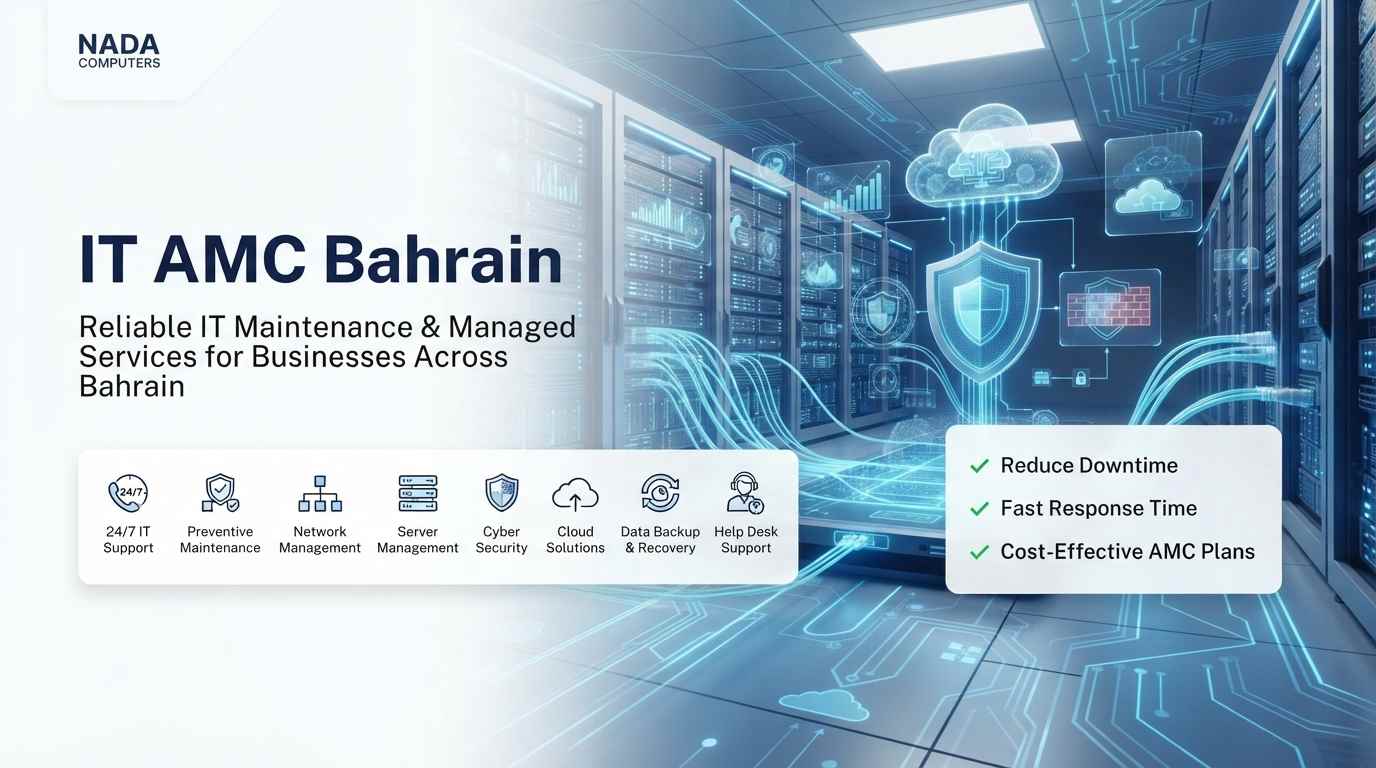
Why every business Needs an IT AMC Bahrain in 2026?Ask any operations manager in Manama what keeps them up at night, and IT rarely tops the list, until the morning the accounts server refuses to boot during month-end closing.
That is the strange thing about technology in business. It is invisible when it works and catastrophic when it doesn’t. A decade ago, a dead PC meant one employee sat idle for a day. Today, a failed switch in your server room can stop invoicing, halt the point-of-sale terminals in three branches, cut off the sales team’s access to email, and leave your customers wondering why nobody is answering.
Bahrain’s business environment has shifted quickly. Cloud adoption accelerated after the government’s cloud-first policy, hybrid work stuck around after the pandemic rather than fading, and data protection obligations under the Personal Data Protection Law gave every company a legal reason to care about how its systems are secured. Meanwhile, the threats got smarter and the tolerance for downtime got thinner.
Which brings us to a question a lot of Bahraini business owners are finally asking out loud: is it still sensible to call an IT technician only after something breaks?
For most companies, the honest answer is no. And that is exactly the gap an IT AMC in Bahrain is designed to close.
Reactive vs Proactive IT Support

Most small and mid-sized businesses in Bahrain start out reactive. It feels economical. You don’t pay anyone until something goes wrong, and when it does, you call a technician, pay the callout charge, and move on.
Reactive IT support is essentially firefighting. The problem announces itself — a server crashes, a printer disappears from the network, ransomware encrypts a shared folder — and the response begins after the damage has already started.
Proactive IT maintenance flips the sequence. Systems are monitored continuously, patches are applied on schedule, backups are tested rather than assumed, hardware health is checked before components fail, and small anomalies get investigated while they are still small.
Here is a real pattern we see repeatedly in Bahrain. A company’s file server has one failing drive in a RAID array. Under a reactive model, nobody notices — the array is tolerating the failure quietly. Three months later a second drive fails, the array collapses, and the business discovers its last usable backup is eleven weeks old. What should have been a BD 90 drive replacement becomes a week of chaos and, in several cases we’ve seen, permanently lost data.
Under a proactive model, that first drive failure triggers an alert on day one. An engineer swaps it during off-hours. Nobody in the business ever finds out it happened.
Reactive vs Proactive: Side-by-Side Comparison
| Factor | Reactive IT Support | Proactive IT Maintenance (AMC) |
|---|---|---|
| When action happens | After failure | Before failure |
| Cost structure | Unpredictable, spikes during crises | Fixed annual fee, budgeted in advance |
| Response time | Depends on technician availability | Defined SLA, priority queue |
| Downtime | Hours to days | Minutes, often zero |
| Backup verification | Rarely tested | Tested on a set schedule |
| Security patching | Whenever someone remembers | Scheduled and documented |
| Hardware lifespan | Shortened by heat, dust, neglect | Extended through routine servicing |
| Business risk | Carried entirely by you | Shared with your IT partner |
| Documentation | Usually none | Asset register, network map, reports |
| Best suited to | Home offices, 1–3 devices | Any business that loses money when systems stop |
The pattern is straightforward. Reactive support is cheaper on paper and far more expensive in practice.
The Hidden Cost of IT Downtime for Businesses
When business owners calculate the cost of downtime, they usually think about the repair invoice. That is the smallest number in the equation.
Lost productivity
Take a 25-person company where the average fully loaded salary cost is BD 700 a month. That’s roughly BD 4 per working hour per employee. A four-hour outage that stops everyone from working costs BD 400 in wages alone — for people sitting in an office, unable to do the job they were paid for. Run that math on your own headcount before you decide an AMC is expensive.
Direct revenue loss
For a retail chain, a POS outage during peak evening hours means transactions that simply never happen. For a logistics firm, a warehouse management system failure means trucks idling in Sitra. For a clinic, it means appointments cancelled and rescheduled. These sales don’t get postponed to tomorrow. They are gone.
Damaged customer trust
This is the cost nobody puts in a spreadsheet, and it is often the largest. A customer who emails you twice and gets no reply because your mail server was offline doesn’t know why. They just conclude you’re unresponsive. In a market as compact and relationship-driven as Bahrain, where reputation moves fast through business circles, that impression is expensive to reverse.
Emergency repair premiums
Urgent, out-of-hours callouts cost significantly more than scheduled maintenance. Add express shipping for a replacement part that isn’t in stock locally, and a single incident can consume a meaningful chunk of what a full year of AMC coverage would have cost.
Security exposure
Unpatched systems are the single most common entry point for ransomware. Attackers scan continuously for known vulnerabilities in Windows Server, firewalls, VPN appliances, and remote desktop services. Once inside, they encrypt shared drives and demand payment. Under Bahrain’s Personal Data Protection Law, a breach involving customer data brings regulatory obligations on top of operational recovery — a compliance problem stacked on an IT problem.
What Is an IT AMC?
An IT Annual Maintenance Contract (AMC) is a service agreement in which an IT company takes responsibility for maintaining your technology infrastructure for a fixed period — usually twelve months, in exchange for an agreed fee.
Think of it the way you think about servicing your fleet vehicles. You don’t wait for the engine to seize before booking a service. You do it on a schedule, because scheduled servicing is cheaper than an engine rebuild and far cheaper than a vehicle stuck on the Shaikh Khalifa Highway.
A properly structured IT support contract in Bahrain typically covers:
- Scheduled preventive maintenance visits, on-site and remote
- Priority helpdesk support with a defined response time
- Server, network, and endpoint monitoring
- Operating system and security patch management
- Antivirus and endpoint protection management
- Backup configuration, monitoring, and restore testing
- Firewall, switch, and access point maintenance
- Basic user support — password resets, email issues, printer problems
- Hardware diagnostics and coordination of repairs or replacements
- Documentation of your IT assets and network configuration
- Periodic reporting on system health and recommendations
Common AMC coverage models
Comprehensive AMC
Labour, support, and replacement parts are all included. Higher fee, minimal surprises. Suits businesses that want a single predictable line item.
Non-comprehensive AMC
Labour and support are included; parts are billed separately. Lower fee, some variability. Suits companies with newer hardware still under warranty.
Remote-only AMC
Monitoring, patching, and helpdesk delivered remotely, with on-site visits charged as needed. Suits small offices with straightforward setups.
Key Benefits of an IT AMC
Predictable IT costs.
One agreed annual figure replaces a scatter of unplanned invoices. Finance can budget properly instead of absorbing shocks.
Faster response when it matters.
AMC clients sit in a priority queue with a contractual response time. Non-contract clients wait until an engineer is free.
Preventive maintenance.
Cleaning dust from server fans, checking UPS battery health, reviewing disk health, verifying cooling — unglamorous work that quietly prevents most failures. In Bahrain’s climate, heat and dust genuinely shorten equipment life, and server rooms that lose cooling during a July afternoon can go from fine to failed in under an hour.
Security patching and updates.
Handled on a documented schedule rather than whenever someone happens to remember.
Continuous monitoring.
Alerts on disk space, failed backups, unusual login attempts, and offline devices — problems caught while they are still cheap.
Real business continuity.
Tested backups, documented recovery steps, and a partner who already knows your environment. Recovery becomes a procedure rather than an improvisation.
Less downtime overall.
The compounding benefit of everything above.
Longer hardware lifespan.
Well-maintained servers and network equipment routinely run one to two years longer than neglected ones, which pushes capital expenditure further out.
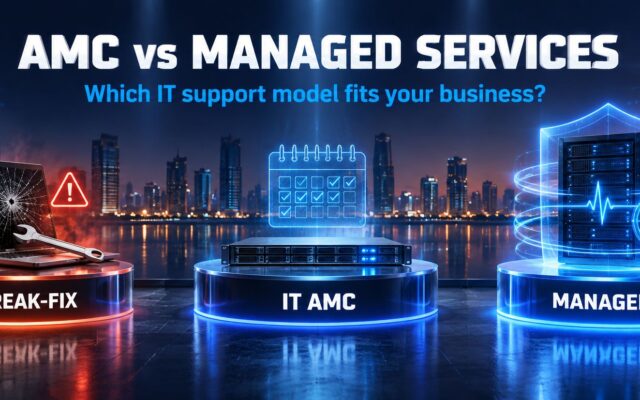
Managed IT Services vs Traditional AMC
The terms get used interchangeably in the Gulf market, but they describe genuinely different service models. The distinction matters when you’re comparing quotes.
| Aspect | Traditional IT AMC | Managed IT Services |
|---|---|---|
| Core focus | Maintaining existing infrastructure | Running IT as an ongoing function |
| Scope | Defined equipment list | Full IT environment, including cloud |
| Strategy | Generally not included | IT roadmap and planning included |
| Monitoring | Periodic or basic | Continuous, 24/7 |
| Cloud management | Usually excluded or add-on | Typically included |
| Security posture | Antivirus and patching | Layered security management |
| Reporting | Visit reports | Regular performance and risk reviews |
| Pricing | Annual fee, often per device | Monthly, usually per user |
| Vendor coordination | Limited | Handled on your behalf |
| Best for | SMEs with stable, on-premise setups | Growing or cloud-heavy organisations |
Choose a traditional AMC
if you have a stable on-premise environment, existing hardware you want to protect, a limited IT budget, and no internal IT staff. This describes a large share of Bahraini SMEs, factories, and retail operations.
Choose managed IT services
if you’re running significant cloud workloads, operating across multiple sites, working under regulatory obligations such as Central Bank of Bahrain requirements, or scaling quickly enough that IT planning has become a strategic question rather than a maintenance one.
Plenty of businesses land somewhere in between — an AMC for on-premise infrastructure plus managed coverage for Microsoft 365 and cloud services. A good provider will build that hybrid rather than push you toward whichever package is more profitable for them.
Why Bahrain Businesses Specifically Need an IT AMC in 2026
Cyber threats have moved down-market
Attackers no longer focus only on large enterprises. Automated campaigns scan every IP range, and smaller companies are targeted precisely because their defences are weaker. A 15-person trading company in Manama is a legitimate target — not because it’s valuable, but because it’s easy.
Hybrid work expanded the perimeter
Staff connect from home, from client sites, from abroad. VPNs, remote desktops, and cloud file sharing all need maintaining and monitoring. The old model — one office, one firewall, one network — no longer describes how work actually happens.
Cloud adoption created a management gap
Bahrain has been an early regional mover on cloud, and plenty of local businesses now run Microsoft 365, cloud backups, and hosted applications. But cloud services still need identity management, licence oversight, security configuration, and backup — misconfigured cloud environments cause as many incidents as failing hardware.
Compliance obligations have real teeth
The Personal Data Protection Law applies to organisations handling personal data in Bahrain. Regulated sectors carry additional requirements. Demonstrating that your systems are maintained, patched, and monitored is far easier when a documented maintenance contract exists.
Continuous operations leave no maintenance window
Hospitality, healthcare, logistics, and retail businesses in Bahrain operate long hours or around the clock. There is no convenient Sunday morning to take systems down. Maintenance has to be planned, staged, and executed by people who know the environment.
Vision 2030 pressure is real
Digital transformation targets under Bahrain’s Economic Vision 2030 have pushed digitisation across sectors. Digitising a process makes the business more efficient — and more dependent on the systems underneath. Dependence without maintenance is just concentrated risk.
9 Signs Your Business Needs an IT AMC
- You only call IT when something is already broken. By definition, you’re absorbing every failure at full cost.
- Nobody can confirm when your backups were last tested. An untested backup is a hope, not a plan.
- Your server is more than four years old and has never been serviced. Dust, heat, and worn drives are accumulating quietly.
- Staff have a “workaround” for a recurring problem. Workarounds are unpaid productivity leaks that everyone has stopped mentioning.
- You don’t have a list of your IT assets. If you can’t say what you own, you can’t say what’s at risk.
- Windows updates are postponed indefinitely. Every deferred patch is an open door.
- One employee is your unofficial IT person. They have another job, and when they resign, the knowledge leaves with them.
- You’ve had more than one unplanned outage this year. A pattern, not bad luck.
- Your IT spending is unpredictable month to month. Volatility in an operating cost is usually a symptom of reactive management.
How to Choose the Right IT AMC Provider in Bahrain?

Insist on a written SLA with actual numbers. “Fast response” means nothing. “Four-hour on-site response for critical incidents during business hours” means something you can enforce.
Confirm they have local engineers. Remote support handles a lot, but a dead power supply requires hands in your server room. Ask how many engineers are based in Bahrain and what their coverage hours are.
Ask what is excluded. The exclusions list tells you more about a contract than the inclusions list. Parts? After-hours callouts? Third-party software? New device onboarding? Get it in writing.
Check relevant sector experience. A provider who has supported factories understands industrial networks and ruggedised equipment. One who has supported clinics understands uptime sensitivity and data confidentiality. Ask for references in your sector.
Require documentation as a deliverable. Your provider should produce and maintain an asset register and network documentation — and you should own a copy. This protects you if you ever change providers.
Review the reporting cadence. Quarterly reports showing incidents, resolutions, and recommendations demonstrate that preventive work is genuinely happening.
Verify security capability. Ask specifically how they handle patch management, endpoint protection, and backup verification. Vague answers are informative.
Be sceptical of the cheapest quote. An AMC priced well below the market usually means minimal preventive work and heavy reliance on billable extras. Compare scope, not just the number.
Why Businesses Across Bahrain Work With Nada Computers?
Nada Computers W.L.L. has supported Bahraini organisations across manufacturing, retail, healthcare, education, hospitality, and professional services — environments with very different tolerances for downtime and very different technical realities.
Experienced local engineers. A Bahrain-based team that can be on site when a problem needs physical hands, not just a remote session.
Response times that reflect business impact. Critical incidents are treated as critical. Priority is defined in the agreement, not decided ad hoc.
A business-first approach. Recommendations are framed around operational risk and cost, not technical novelty. If replacing a device isn’t necessary this year, we’ll say so.
Genuine preventive maintenance. Scheduled visits, backup verification, patch management, and health monitoring — the routine work that keeps the emergency calls from happening.
AMC plans built around your environment. A five-person office and a forty-user factory shouldn’t buy the same contract. Coverage is scoped to what you actually run and what you can actually afford.
Alongside AMC coverage, Nada Computers works across managed IT services, cloud solutions, cyber security, networking, server infrastructure, and Microsoft 365, which means your maintenance partner can also support you as the environment grows.
Final Thoughs
The businesses that treat IT as an emergency expense end up paying for it twice — once in repair bills and again in the productivity, revenue, and customer trust lost while systems were down.
An IT AMC changes the economics. It converts an unpredictable risk into a planned, budgeted cost. It shifts the work from repair to prevention. And it gives you a partner who already understands your environment before something goes wrong, rather than a stranger learning it under pressure at 9 p.m. on a Thursday.
In 2026, with threats increasing, work distributed, and compliance expectations firm, that is no longer an upgrade. For most Bahraini businesses, it’s the baseline.
Considering an IT AMC for your business? Contact Nada Computers for a straightforward assessment of your current setup and a maintenance plan scoped to what your organisation actually needs. No obligation, no jargon — just a clear picture of where your risks sit.
FAQs
What is an IT AMC in Bahrain?
An IT AMC in Bahrain is an annual maintenance contract between a business and an IT services provider. The provider maintains your servers, networks, computers, and software for a fixed yearly fee. Coverage typically includes scheduled preventive maintenance, priority technical support, security patching, system monitoring, and backup management. Instead of paying separately each time something breaks, you pay one agreed amount and the provider takes ongoing responsibility for keeping your systems running reliably throughout the year.
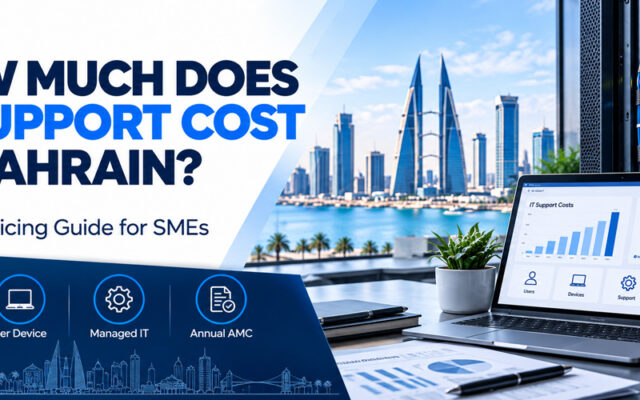
How much does an IT AMC cost in Bahrain?
IT AMC pricing in Bahrain depends on the number of users and devices, the complexity of your infrastructure, whether servers are included, the response times you require, and whether replacement parts are covered. A small office with a handful of workstations sits at the lower end; a multi-site operation with servers and network infrastructure sits higher. Most providers price per device or per user annually. Request a scoped quote after a site assessment rather than accepting a flat figure quoted over the phone.
What is the difference between an AMC and managed IT services?
A traditional AMC focuses on maintaining a defined list of existing equipment — servicing, repairing, and supporting what you already own. Managed IT services cover your entire IT function, including cloud platforms, continuous 24/7 monitoring, security management, strategic planning, and vendor coordination. AMCs suit businesses with stable on-premise setups and limited budgets. Managed services suit growing, cloud-heavy, or regulated organisations. Many Bahraini businesses combine both — an AMC for hardware and managed coverage for cloud services.
What does an IT AMC typically include?
A standard IT AMC includes scheduled preventive maintenance visits, priority helpdesk support with a defined response time, server and network monitoring, operating system and security patch management, antivirus administration, backup configuration and restore testing, firewall and switch maintenance, user support for everyday issues, hardware diagnostics, and documentation of your IT assets. Comprehensive contracts also cover replacement parts. Always confirm the exclusions list in writing, since that defines the real scope of any agreement.
How does an IT AMC reduce business downtime?
An IT AMC reduces downtime by shifting from repair to prevention. Continuous monitoring flags failing drives, full disks, failed backups, and unusual activity before they cause outages. Scheduled maintenance addresses dust, cooling, and worn components that cause hardware failure. Regular patching closes security gaps that lead to ransomware incidents. And when something does go wrong, a contracted engineer already knows your environment — which shortens diagnosis dramatically compared with a technician arriving cold.
Do small businesses in Bahrain really need an IT support contract?
Yes, often more than large companies do. Small businesses rarely have internal IT staff, so a single failure can halt operations entirely with nobody available to respond. They’re also actively targeted by automated cyberattacks precisely because their defences are typically weaker. An AMC gives a small business professional IT coverage at a predictable annual cost — usually far less than the productivity and revenue lost to a single serious outage.